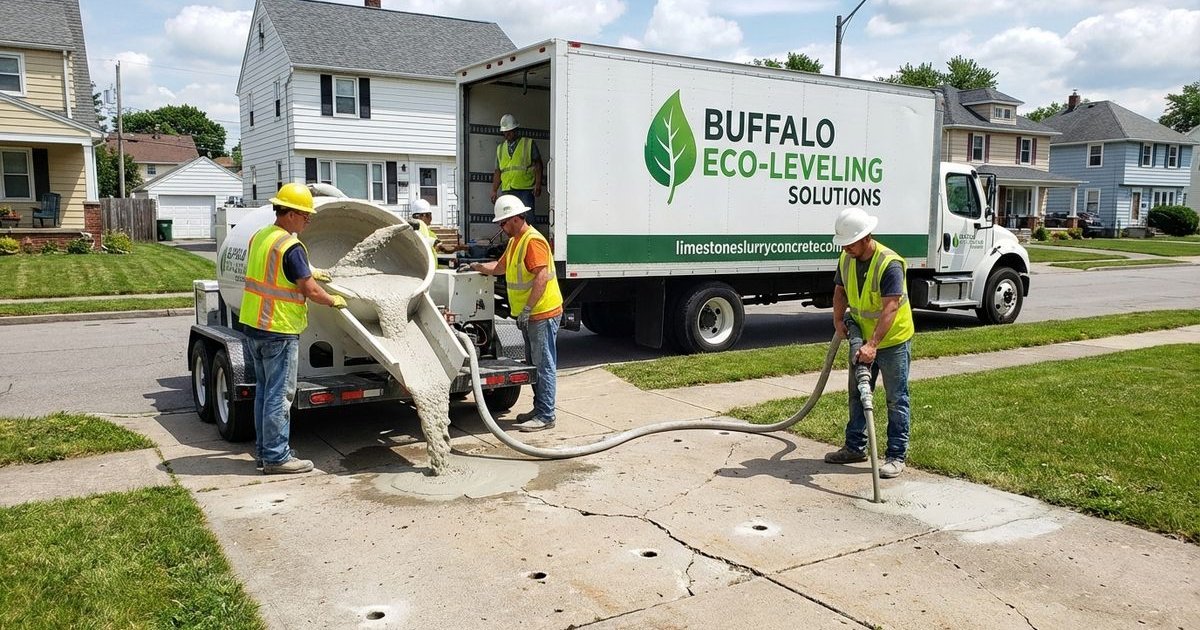
With over 30 years of concrete leveling experience in Buffalo, we have seen methods come and go. Polyurethane foam leveling is the current marketing darling, but we continue to use limestone slurry. Here is why.
What is Limestone Slurry?
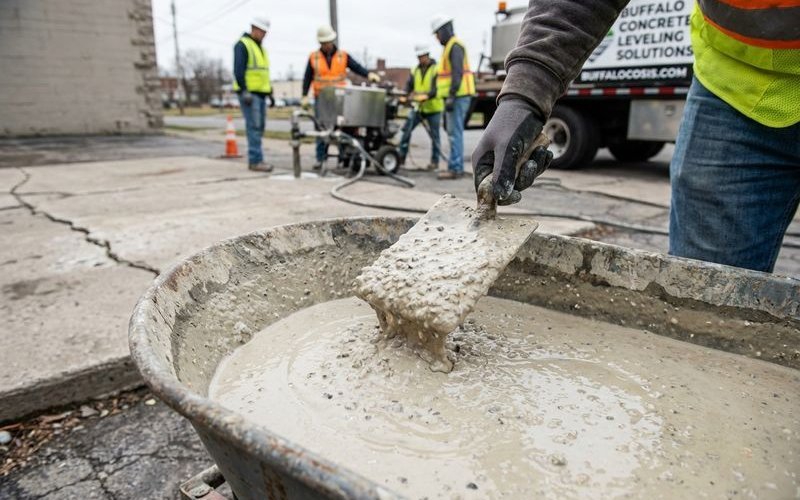
Limestone slurry is a high-density mixture designed to replicate the strength of the slab it supports. This compound consists of:
- Pulverized Limestone: Often referred to as agricultural lime, this provides the bulk density.
- Portland Cement: This binding agent allows the mixture to harden to a specific strength.
- Water: Creating a fluid consistency that allows the material to flow into even the smallest voids before curing.
When pumped beneath concrete, it flows into voids, lifts the slab, and hardens into a material similar to concrete itself. Highway departments and municipalities have relied on this specific composition for over 50 years because it creates a permanent, rock-hard base.
Reason 1: Proven Compressive Strength
The most significant difference between the two methods is the density of the final product. Cured limestone slurry typically achieves a compressive strength of roughly 2,400 PSI (pounds per square inch).
Why this number matters:
- Matches Your Concrete: Standard residential concrete is usually 3,000-4,000 PSI.
- Supports Heavy Loads: Your driveway needs to support SUVs, trucks, and delivery vehicles without crushing the base.
- Resists Fatigue: A dense base won’t compress over decades of use.
Polyurethane foam, by comparison, usually offers a compressive strength of 50 to 100 PSI. While this is often sufficient to hold up a slab, we prefer a material that effectively extends the concrete itself rather than resting it on a pillow of plastic.
Reason 2: Superior Stability Against Hydrostatic Pressure
Weight is often marketed as a negative by foam installers, but in Western New York, weight is your ally. Limestone slurry weighs approximately 140 lbs per cubic foot, which is nearly identical to the soil and concrete it replaces.
The “Ballast” Effect:
- Resists Water Lift: During heavy rains or snowmelt, groundwater exerts upward pressure (hydrostatic pressure) on your concrete.
- Anchors the Slab: The heavy slurry acts as an anchor, preventing the slab from “floating” or shifting when the ground gets saturated.
- Mimics Native Soil: It reintegrates with the sub-base rather than sitting on top of it like a foreign object.
Foam weighs only 2-4 lbs per cubic foot. In high-water table areas—common in Buffalo suburbs—lightweight materials can sometimes fail to provide the necessary resistance against hydraulic lift.
Comparison: Limestone Slurry vs. Polyurethane Foam
| Feature | Limestone Slurry | Polyurethane Foam |
|---|---|---|
| Material Base | Crushed Stone & Cement | Chemical Polymer (Plastic) |
| Compressive Strength | ~2,400 PSI | ~100 PSI |
| Weight (Density) | ~140 lbs/cu ft | ~3 lbs/cu ft |
| Cure Time | 24 Hours for vehicles | 15-30 Minutes |
Reason 3: Built for Buffalo’s Freeze-Thaw Cycles
Our region experiences dozens of freeze-thaw events every winter, where the ground freezes, expands, thaws, and contracts rapidly. This movement is the primary enemy of concrete.
How limestone handles the “Lake Effect”:
- Water Impermeability: Once cured, the slurry forms a dense, stone-like mass that sheds water rather than absorbing it.
- Thermal Mass: The density of the material resists rapid temperature changes, providing a more stable temperature buffer for the slab above.
- Proven Longevity: We have revisited driveways we leveled in the mid-1990s that remain perfectly level despite thirty winters of abuse.
Reason 4: True Soil Stabilization
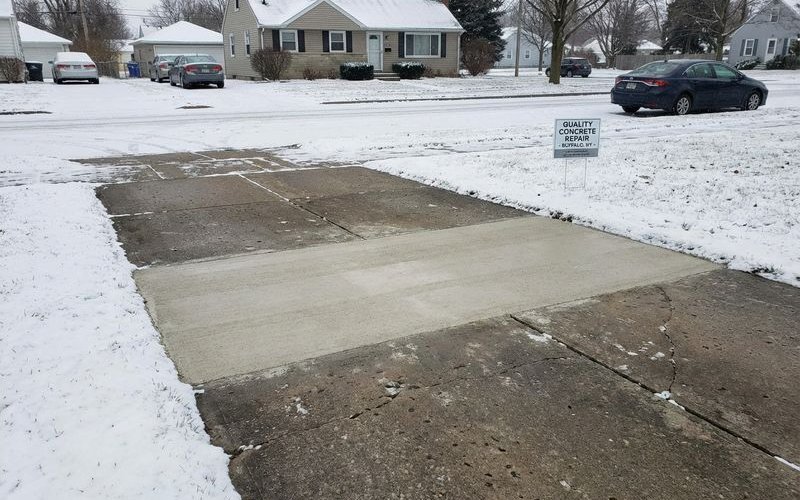
Limestone slurry does not just lift the slab; it stabilizes the sub-grade through a process known as compaction grouting.
- Fills the Micro-Voids: The fluid nature of the slurry allows it to travel into loose soil pockets and rodent tunnels that stiff foam might bridge over.
- Compresses Weak Soil: As the heavy slurry is pumped in, it physically compresses the loose soil underneath, creating a broader, firmer base.
- Eliminates Erosion Paths: By filling the entire void with a solid mass, it prevents water from finding a path to run under the slab and cause future erosion.
Foam expands rapidly to lift the slab, but it does not always densify the soil below it in the same way a pressurized cementitious slurry does.
Reason 5: The Cost Reality
For most homeowners, the bottom line is a major factor. Limestone slurry typically costs than polyurethane foam.
Where the savings come from:
- Material Cost: We use locally sourced natural stone and cement, not patented chemicals manufactured in a factory.
- No Licensing Fees: We don’t pay franchise fees for a proprietary foam brand, passing those savings directly to you.
- Simple Efficiency: The process is straightforward and relies on materials that are abundant in New York.
We could charge higher prices for “new technology” to increase our margins. However, our goal is to provide the most effective repair at the fairest price, and slurry allows us to do exactly that.
Reason 6: Environmentally Responsible
For those concerned about the ecological footprint of home repairs, limestone is the clear winner.
- Natural Ingredients: The material is literally rock, water, and cement.
- Inert Curing: It hardens into stone without off-gassing.
- Recyclable: If the concrete is ever removed in the future, the slurry can be crushed and recycled just like the concrete itself.
Polyurethane foam is a petroleum-based product containing isocyanates. While modern foams are generally safe once cured, they are still synthetic plastics being injected permanently into the earth.
Reason 7: Predictable Control
Our process has been refined over 30+ years to ensure absolute precision.
- Visual Confirmation: We can see the material flowing and know exactly where it is going.
- No Over-Lifting: Hydraulic pressure lifts the slab gently and evenly.
- Mechanical Reliability: Our equipment is optimized for this specific density, reducing the risk of equipment failure or mix-ratio errors on the job site.
Innovation is valuable, but consistency is vital when dealing with your home’s foundation.
What About Foam’s Advantages?
To be fair, foam has some legitimate benefits in specific scenarios.
- Weight-Sensitive Sites: If a slab is over a septic tank or unstable fill that literally cannot support weight, foam is superior.
- Immediate Traffic: If a commercial loading dock needs to be used 15 minutes after the repair, foam is the only option.
- Tight Access: The equipment for foam is smaller, making it easier to reach difficult spots like fenced-in backyards.
However, for 95% of residential driveways, sidewalks, and patios in Buffalo, these niche advantages do not outweigh the durability and stability of limestone.
The Bottom Line
We use limestone slurry because it aligns with our core values of durability and value.
- Strength: 2,400 PSI base vs. 100 PSI foam.
- Stability: Heavy mass resists shifting and water pressure.
- Value: Significantly lower cost for a material that lasts longer.
- Eco-Friendly: Natural stone vs. synthetic plastic.
- History: 30+ years of proven results in WNY weather.
We are not against new technology; we are simply against replacing a superior material with an inferior one just because it is trendy. When something works this well, we stick with it.
Questions?
If you would like to discuss the merits of different leveling methods for your specific project, we are happy to explain our approach in detail. Contact us anytime to get an honest assessment of what your concrete needs.