Why Is My Driveway Sinking? Common Causes in Buffalo NY
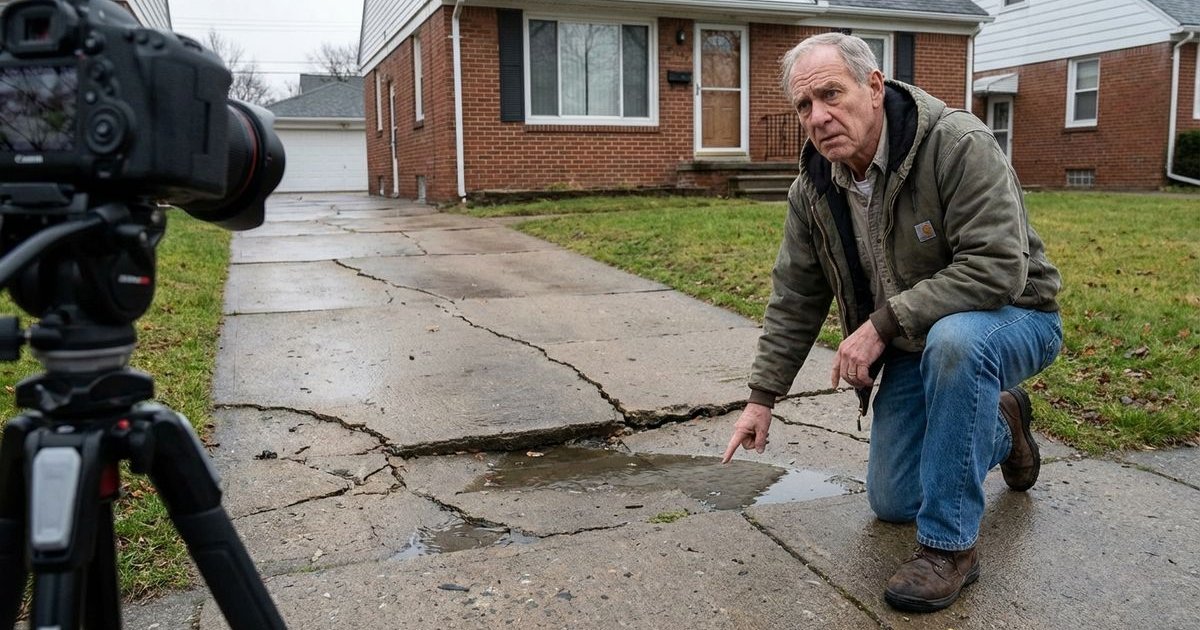
You’ve noticed it, haven’t you? That section of your driveway that’s lower than it used to be. Maybe water pools there now, or you feel a sickening “thump” every time you pull in. Why is this happening?
Getting to the root cause is the only way to choose a permanent fix.
We see this every day across Western New York. From what we’ve observed in 2025 and early 2026, the issue isn’t usually the concrete itself—it’s what’s happening underneath it. The record-breaking warmth of 2024 followed by the wet winter of 2025 created the perfect storm for soil movement.
Let’s break down the data, explain the specific soil mechanics at play in Erie County, and walk through the repair options that actually last.
The #1 Cause: Soil Erosion
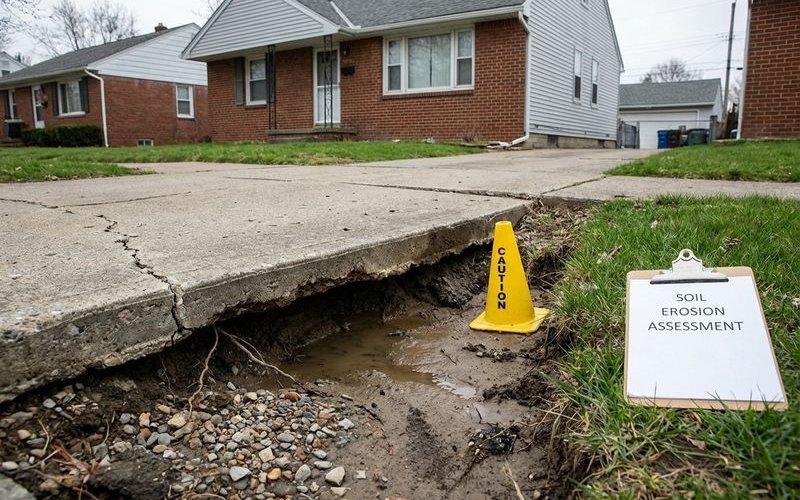
In most cases, your driveway isn’t sinking—the soil beneath it is washing away. Without solid support, the concrete settles into the void.
How soil erodes:
- Water flows along the underside of concrete edges
- Each rain event washes away small amounts of soil
- Over years, significant voids develop
- Eventually, the concrete drops into the void
This is why driveways often settle at the edges first or where water tends to flow.
The “Glacial Till” Factor
Here in Buffalo, we aren’t building on solid rock. Much of our region sits on “glacial till” and “lacustrine clay,” which are soils left behind by ancient lakes. These soil types are notoriously unstable. When they get wet, they turn into a sticky slurry that easily washes out through gaps in your curb or into the gravel sub-base.
We often find that a single disconnected downspout can wash out enough of this fine silt to drop a driveway slab by two inches in a single season.
Buffalo’s Freeze-Thaw Cycles
Western New York’s climate is particularly hard on driveways. The sheer frequency of our temperature swings is the real enemy.
The Mechanics of the Damage:
- Water enters through cracks, joints, and edges
- Freezing expands the water 9%, widening openings
- Thawing allows more water to enter
- Each cycle washes away more soil
Recent Weather Trends
You might think a milder winter is better, but it’s actually worse for concrete. 2024 was the warmest year on record for Buffalo, yet we still saw over 90 days with freezing temperatures. This means instead of staying frozen solid (which is stable), the ground constantly froze and thawed.
We call this the “pumping effect.” Every time the ground thaws, it turns to mud. When it refreezes, it heaves the concrete up. This constant movement creates pockets of air that eventually cause the slab to crack and sink.
Poor Compaction During Construction
This is a hidden problem that reveals itself years later:
- Builder uses fill dirt to grade the lot
- Fill soil isn’t properly compacted
- Concrete is poured on inadequate base
- Over time, loose soil consolidates
- Concrete settles as soil compresses
Unfortunately, this is extremely common. Many driveways are built on poorly prepared bases.
The “Standard Proctor” Standard
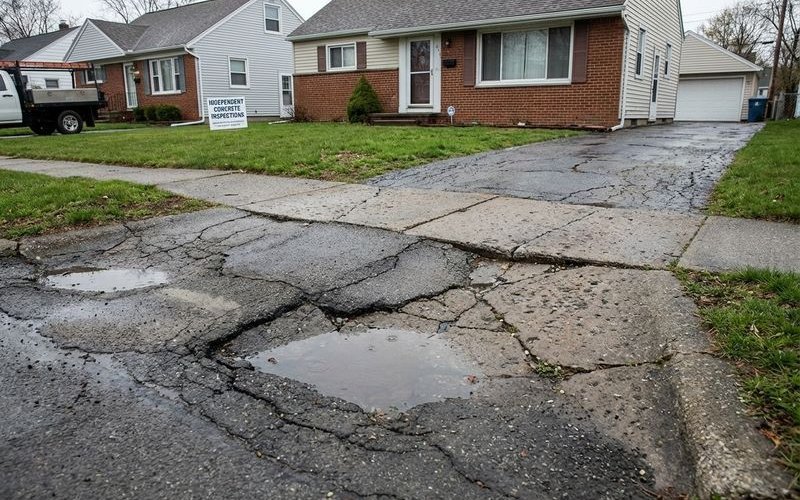
In construction, there is a specific benchmark known as the “Standard Proctor Test” which measures soil density. A driveway base should ideally be compacted to 95% of this standard.
We frequently see driveways where the builder simply backfilled with loose dirt and ran a bulldozer over it once. That might look flat on day one, but gravity always wins. It can take 5 to 10 years for that loose soil to fully settle, which is why your driveway might be sinking now even if your home isn’t brand new.
Organic Material Decomposition
Sometimes there’s organic material beneath your driveway:
- Tree roots from removed trees
- Buried stumps or branches
- Organic-rich soil
- Old landscaping materials
As this material decomposes, it leaves voids that the concrete settles into. This can take years or even decades to manifest.
The Maple and Oak Factor
Buffalo is the “City of Trees,” and our older neighborhoods are lined with Silver Maples and Oaks. These trees have aggressive root systems that can extend far beyond the canopy.
If a large tree was removed near your driveway even 15 years ago, the rotting root mass is likely creating a void right now. We often drill a test hole and find a hollow space that smells like mulch—a telltale sign that an old stump has finally rotted away, leaving your concrete floating on air.
Water Line and Utility Issues
Leaking underground utilities can wash away soil quickly:
- Water line leaks
- Sewer line cracks
- Broken irrigation pipes
- Storm drain problems
If your settling is sudden or localized near utility lines, this may be the culprit. We often recommend having utilities checked before proceeding with leveling.
Understanding Local Infrastructure
The Erie County Water Authority (ECWA) generally buries water mains about 5 feet deep to stay below the 42-inch frost line. However, the service line running to your house is often shallower and more prone to movement.
A small, undetectable leak in a water service line can act like a pressure washer underground, eroding cubic feet of soil in a matter of weeks. If you see a green patch of lush grass next to your sinking driveway during a dry August, that is a major red flag for a leak.
Improper Drainage
Water is the enemy. Poor drainage accelerates all types of settling:
Common drainage problems:
- Downspouts dumping at driveway edge
- Driveway pitched toward foundation
- No edge drainage along driveway
- Neighbors’ runoff flowing onto your property
Addressing drainage issues before or during leveling prevents future problems.
The 10-Foot Rule
Extensions are your best friend. We always advise homeowners to extend downspouts at least 10 feet away from the driveway and foundation.
Most drainage systems in Buffalo just dump water right at the corner of the garage. This saturates the clay soil specifically at the joint where the driveway meets the garage floor, causing that classic “dip” you feel when you pull in.
Heavy Vehicle Traffic
While concrete is designed to handle vehicle weight, repeated heavy loads can accelerate settling:
- Delivery trucks
- RVs and large trailers
- Construction equipment
- Heavy work vehicles
This is especially true if the base wasn’t properly prepared or soil conditions are already weak.
PSI Matters in the North
In Southern states, a 3,000 PSI (Pounds Per Square Inch) concrete mix is standard. In Buffalo, however, we really need 4,000 to 4,500 PSI concrete to withstand the combination of heavy loads and salt damage.
If your driveway was poured with a weaker mix, it will flex under the weight of a heavy delivery truck. Since 2020, the frequency of heavy delivery vans (like Amazon or FedEx) entering residential driveways has skyrocketed. That daily repetitive stress on a weak base is a leading cause of the cracking and sinking we are repairing today.
Can You Stop It From Getting Worse?
Yes. Here’s what helps:
- Address drainage - Get water away from concrete edges
- Seal joints - Prevent water infiltration
- Extend downspouts - Keep roof water away
- Level early - Don’t wait for severe settling
The Solution: Concrete Leveling
Once we understand why your driveway is sinking, we can fix it properly:
- Assess the underlying cause
- Inject limestone slurry to fill voids
- Lift the concrete back to level
- Address drainage if needed
- Seal joints to prevent water entry
Our limestone slurry stabilizes the soil beneath your driveway, preventing future settling from the same cause.
Why Slurry Works Better
You might hear about “polyurethane foam” as an alternative. While foam has its uses, our limestone slurry is a hydraulic cement-based material.
This means it doesn’t just lift the slab; it creates a new, rock-hard sub-base that integrates with the wet clay and silt soils of Western New York. It pushes water out and fills the voids with a material that won’t compress under the weight of your SUV.
Cost Comparison (2025/2026 Estimates)
Making the right choice often comes down to the budget. Here is how leveling compares to full replacement in the Buffalo market right now:
| Feature | Concrete Leveling | Full Replacement |
|---|---|---|
| Cost | $600 - $2,500 (Typical range) | $8 - $20 per sq. ft. ($6k - $12k+) |
| Time to Fix | 2-4 Hours | 3-7 Days |
| Useable In | Immediately | 7+ Days (Cure time) |
| Mess | Minimal (Drill dust) | High (Excavation & Pour) |
Leveling typically saves you 50% to 70% compared to the cost of tearing out and repouring the concrete.
Get a Free Assessment
Wondering exactly why your driveway is sinking? We’ll assess the situation and explain what we find. Contact us for a free evaluation and honest recommendation.