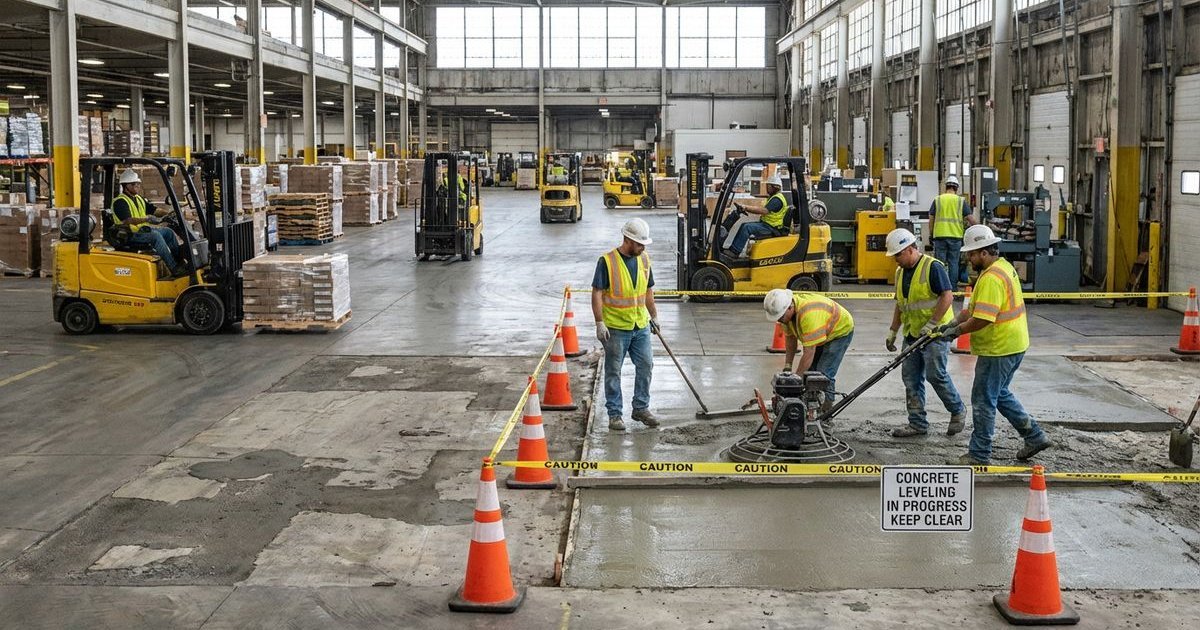
Uneven warehouse floors create safety hazards, damage equipment, and slow operations. Most facility managers dread the repair process because they assume it requires a full shutdown.
Warehouse Floor Leveling: How to Minimize Business Downtime doesn’t have to mean stopping production.
We at Concrete Leveling Buffalo have seen firsthand how disruptive traditional concrete replacement can be. Modern commercial concrete leveling offers a faster alternative that keeps your doors open and your trucks moving.
The Problem with Uneven Warehouse Floors
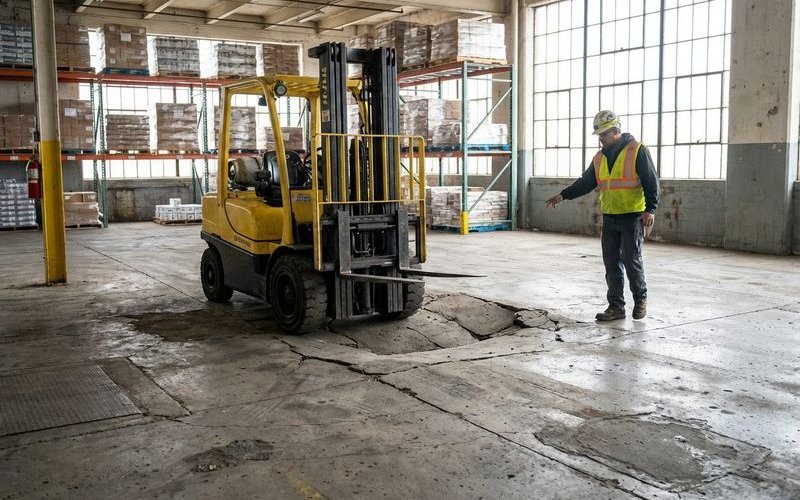
Ignoring a settling slab often leads to expensive consequences beyond just the concrete itself.
Forklift manufacturers specifically design their equipment for flat surfaces. According to OSHA standard 1910.178, keeping aisles clear and in good repair is a federal mandate, not just a suggestion.
Settling warehouse floors cause multiple issues:
- Forklift instability: Uneven surfaces cause load shifts and increase the risk of tipping.
- Racking stress: Floor settling puts dangerous torque on vertical storage systems.
- Trip hazards: A variance of just 1/4 inch can create a significant trip liability for employees.
- Equipment wear: Solid cushion tires on forklifts degrade 30% faster on rough terrain.
- Drainage problems: Water pools in low spots and creates slip risks.
- Operational slowdowns: Drivers instinctively slow down to navigate bumps, reducing picks per hour.
Why Warehouse Floors Settle
Industrial floors face unique challenges that residential slabs never encounter.
Understanding the root cause is necessary to ensure the repair lasts.
Heavy Loads
Warehouses carry far more weight per square foot than residential concrete.
High-capacity pallet racking transmits thousands of pounds of point-load pressure through small base plates. This concentrated force can compress the soil beneath the slab if it wasn’t properly compacted during construction.
Repetitive Traffic
Forklifts travel the same paths repeatedly.
We often see “rutting” patterns in high-traffic aisles where the constant vibration and weight of 10,000-pound machines have pulverized the sub-base.
Original Construction
Many warehouse floors were built to minimal specifications.
Contractors sometimes pour thin slabs on bases that lack the necessary aggregate density. ACI (American Concrete Institute) standards for industrial floors have tightened over the years, meaning older facilities often fall short of modern load requirements.
Water Infiltration
Loading docks and overhead doors allow water entry.
Poorly sealed expansion joints allow moisture to seep under the slab, washing away the supporting soil in a process known as erosion.
The Leveling Solution
Our warehouse floor leveling process addresses these issues without the chaos of demolition.
We utilize a high-density limestone slurry injection method that restores stability and flatness. This material provides the compressive strength needed to support industrial traffic.
1. Pre-Work Planning
We work with you to understand your logistics flow before a single truck arrives.
Your peak hours and shipping schedules dictate our timeline.
- Operating hours and peak shifts
- Critical pathways that can’t be blocked
- Areas that can be addressed first
- Scheduling flexibility
2. Section-by-Section Approach
We don’t need to close your entire warehouse.
Isolating specific aisles allows your team to continue picking and packing in the rest of the facility.
- Complete one area while others remain operational
- Move systematically through the facility
- Coordinate with your operations team
3. Fast Cure Times
Our limestone slurry offers a significant speed advantage over poured concrete.
New concrete typically requires 28 days to reach full cure strength.
- Forklift traffic is often possible within 4-6 hours for most areas
- Full loads can be stored within 24 hours
- No extended cure periods block your operations
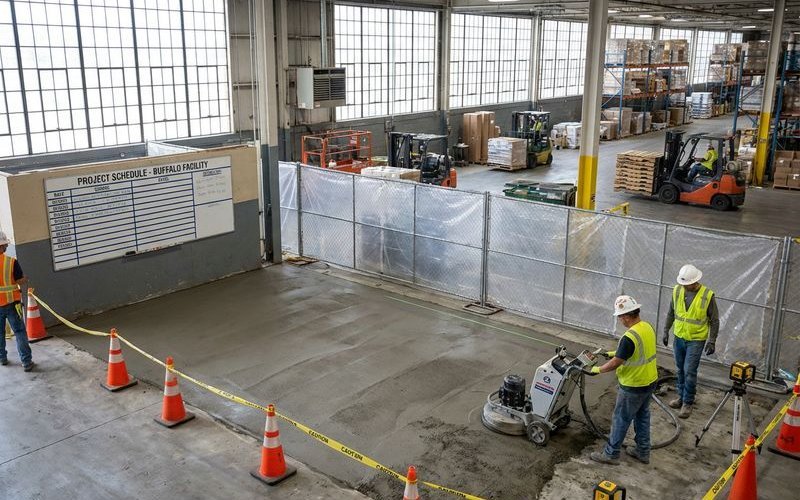
Minimizing Downtime Strategies
Efficiency is the primary goal for any logistics operation.
We have developed specific protocols to ensure our work remains invisible to your customers.
Off-Hours Work
We’re flexible with scheduling to accommodate 24/7 demands.
Many facilities prefer we operate during “skeleton crew” shifts.
- Evening shifts after business hours
- Weekend work when the facility is closed
- Overnight projects for continuous operations
Phased Approach
For large facilities exceeding 50,000 square feet, doing everything at once is impossible.
Breaking the project into “zones” helps maintain workflow.
- Prioritize safety-critical areas first
- Address high-traffic zones during slow periods
- Complete cosmetic areas last
Rapid Mobilization
When you have a shutdown window, speed is everything.
Our crews arrive prepared to maximize every minute of access.
- We bring adequate crew and equipment to scale up production
- Multiple areas work simultaneously
- Maximize productivity in available time
Cost vs. Alternative Solutions
Replacing a concrete slab is capital-intensive and slow.
Facilities managers often look at the price per square foot, but the true cost must include lost revenue during downtime.
| Solution | Est. Cost (Scale) | Downtime | Result |
|---|---|---|---|
| Leveling (Slurry/Injection) | $$ (Low-Mid) | 4-24 Hours | Level, stable floor ready for traffic |
| Self-leveling overlay | $$$ (Mid-High) | 2-4 Days | Smooth surface, but adds height/trip hazards |
| Full replacement | $$$$ (Very High) | 2-3 Weeks | New floor, massive dust & disruption |
| Do nothing | $0 (Upfront) | None | Safety liabilities & equipment damage |
Leveling provides the best balance of cost, downtime, and results.
Data shows that slabjacking or leveling typically costs 50% to 70% less than pouring new concrete.
What to Expect
Professionalism defines our process from the first site visit.
You need a partner who understands industrial safety protocols, not just a general contractor.
Initial Assessment
We’ll walk your facility to perform a detailed audit.
Tools like laser levels allow us to map the floor’s topography accurately.
- Identify all settling areas
- Measure severity of settlement
- Note operational constraints
- Develop a work plan
Proposal
Our proposal includes transparent details to help you secure budget approval.
You will see exactly where every dollar goes.
- Detailed scope of work
- Scheduling options
- Clear pricing
- Expected timeframes
Execution
During the work, safety is our priority.
Our technicians wear appropriate PPE and respect your facility’s traffic rules.
- Clear communication with your team
- Minimal footprint in work areas
- Professional cleanup
- Area released when ready
Industrial-Specific Considerations
We understand warehouse environments have strict requirements.
Residential methods simply do not work in a facility running three shifts a day.
- Load capacity: Our repairs are engineered to handle heavy industrial loads and racking weights.
- Forklift clearance: We ensure joints are flush to prevent “wheel shock” on reach trucks.
- Dust control: We use vacuum-shrouded equipment to minimize airborne particles near inventory.
- Chemical exposure: Our materials are compatible with standard warehouse cleaning solvents.
- Documentation: We provide completion certificates for your safety audits and insurance records.
Get a Facility Assessment
Don’t let floor problems slow your operations or create liability.
Unaddressed settlement rarely resolves itself; it usually accelerates as traffic continues. Contact us for a free warehouse floor assessment.
We’ll evaluate your facility, identify problem areas, and propose a repair plan that minimizes business disruption.
Call (716) 261-2142 to schedule your assessment.