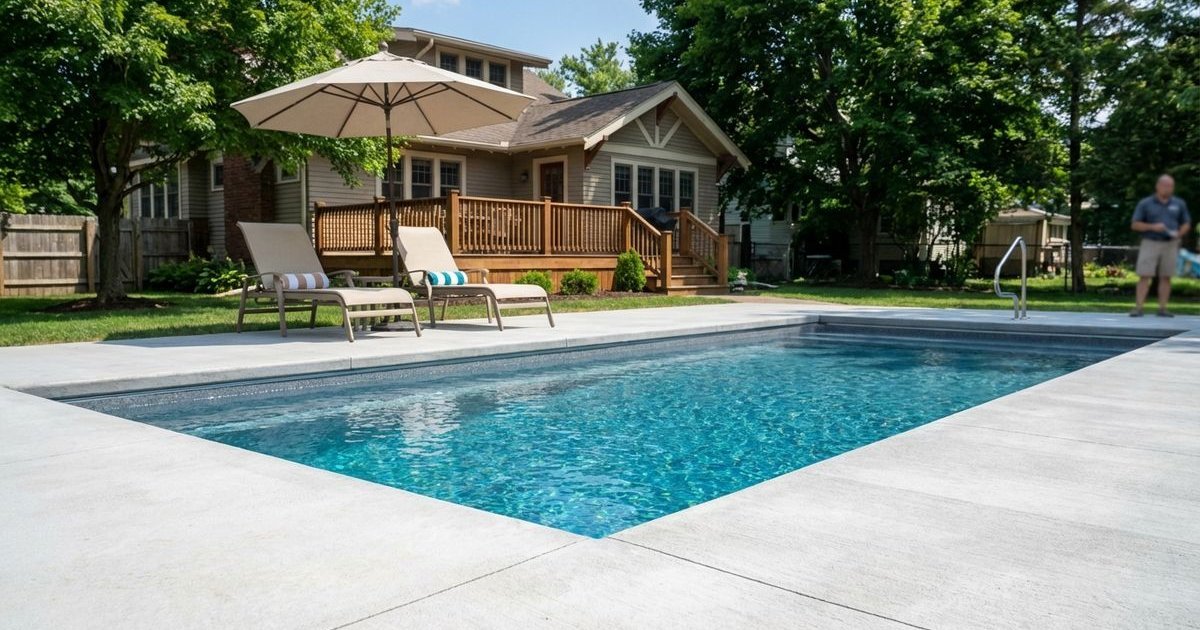
We know how quickly a Buffalo winter can turn a perfect backyard oasis into a safety hazard. The freeze-thaw cycles in Western New York are notorious for wreaking havoc on concrete slabs.
You have likely noticed that distinct shift in your concrete where one slab sits higher than the other. This isn’t just an eyesore that ruins the look of your pool area—it’s exactly what professional pool deck leveling is designed to fix.
Uneven concrete creates dangerous trip hazards in an environment that is already wet and slippery. We see this issue affect family safety and property value every season.
Here is the practical breakdown of why this happens and how we fix it for good.
Why Buffalo Pool Decks Settle
Pool decks in our region face specific geological and environmental pressures that accelerate settling.
1. The Clay Soil Factor
Western New York is famous for its heavy clay soil composition. This soil type expands significantly when wet and shrinks when dry. The constant movement creates voids under your concrete slabs that eventually cause them to sink.
2. Backfill Instability
We often see issues arise from the original pool construction process. Contractors must excavate a massive amount of earth to install the pool shell. The soil put back around the pool (backfill) often takes 7 to 10 years to fully compact naturally.
3. Freeze-Thaw Abuse
Buffalo averages over 60 freeze-thaw cycles annually. Water gets under the slab, freezes, and heaves the concrete up. When the ice melts, the slab settles back down, often unevenly.
4. Chemical Erosion
Pool water is chemically treated water. Over time, splashes of chlorinated or saltwater can degrade the soil integrity if cracks allow water to seep beneath the deck.
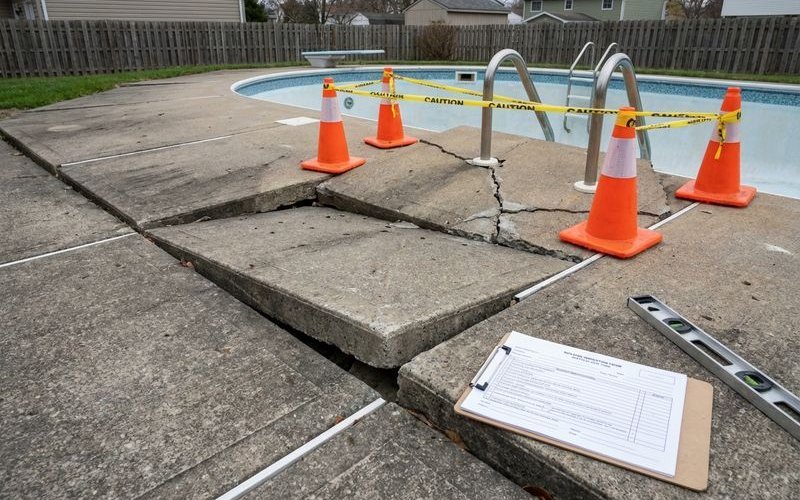
Common Pool Deck Problems We Fix
We encounter specific failure patterns that signal it is time for repair.
- Positive Slopes: Slabs tilting toward the pool, dumping dirty runoff into your clean water.
- The “Toe-Stubber”: Vertical displacement between slabs exceeding 1/4 inch (the ADA definition of a trip hazard).
- Coping Separation: A visible gap opening up between the concrete deck and the pool’s coping stone or liner track.
- Pooling Water: Low spots where water sits stagnant instead of draining off.
The Safety and Liability Issue
The risks associated with uneven pool decks go beyond a scraped knee.
The Financial Reality According to the National Floor Safety Institute, the average cost of a slip-and-fall claim can exceed $30,000. Homeowner insurance premiums often spike following a liability claim.
Vulnerable Guests Your pool area is a high-traffic zone for the people most at risk.
- Children: Running with wet feet makes them prone to tripping on elevated edges.
- Seniors: Older guests have reduced stability and are at higher risk for bone fractures from falls.
Even a minor half-inch lip becomes a major liability when the surface is wet.
Our Limestone Leveling Process
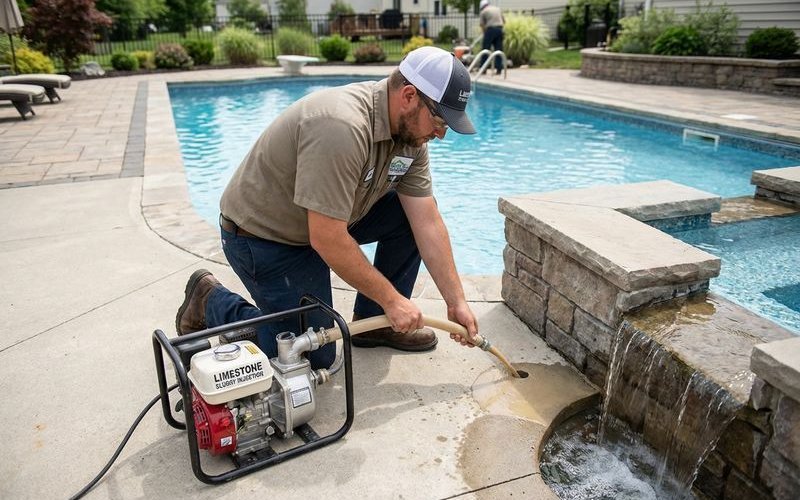
We utilize a time-tested, environmentally friendly method known as limestone slurry injection (mudjacking). This process offers superior stability for the heavy traffic of a pool deck.
1. Technical Assessment
We start by mapping the void structures beneath your concrete. This step includes locating skimmer lines, return jets, and electrical conduits to ensure zero damage to your pool systems.
2. Strategic Access Points
Technicians drill small, dime-sized holes in precise locations. We place these strategically in grout lines or inconspicuous spots whenever possible to maintain aesthetics.
3. Hydraulic Lifting
We pump a mixture of natural limestone and water into the voids under high pressure. This slurry fills every crevice and gently lifts the slab back to its original position. The limestone material solidifies to become harder and more stable than the surrounding soil.
4. Same-Day Use
The project is typically finished in 2 to 4 hours. You can walk on the deck immediately after we finish, and you can place heavy patio furniture back on it within 24 hours.
Is This Safe for My Pool?
Yes, this method is specifically preferred for pool areas.
Material Safety We use a limestone mixture that is natural and chemically inert. It poses no risk to your pool water chemistry, pets, or local groundwater.
Protection of Equipment The pressure used in our process is controlled and precise. We monitor the lift in real-time to ensure no stress is placed on the pool walls or plumbing lines.
Zero Downtime You do not need to drain your pool. The water stays in, and the fun continues as soon as we leave.
Drainage: The Hidden Priority
Leveling is about more than just a flat surface. We focus heavily on restoring the “pitch” or slope of your concrete.
Proper drainage protects your investment in three ways:
- Debris Control: Water should flow away from the pool so dirt and grass clippings wash into the grass, not your filter.
- Foundation Safety: Water must be directed away from your home’s foundation to prevent basement leaks.
- Erosion Prevention: Proper runoff prevents water from undermining the slab again in the future.
Standard code suggests a slope of one-quarter inch per foot. We aim to restore this gradient to keep your deck dry and safe.
When to Schedule Service in Buffalo
Timing matters when dealing with Western New York weather.
| Season | Pros | Cons |
|---|---|---|
| Spring (April-May) | Best Time. Deck is ready before opening. | Schedule fills up fast. |
| Summer (June-Aug) | Good for immediate fixes. | Interrupts pool usage for a few hours. |
| Fall (Sept-Oct) | Best Time. Fixes settling before winter freeze. | Weather is unpredictable. |
| Winter (Nov-Mar) | Not Recommended. | Ground is frozen; slurry cannot cure properly. |
We recommend booking in early spring to beat the “opening day” rush.
Cost Breakdown: Leveling vs. Replacement
The price difference between leveling your concrete and replacing it is substantial.
In 2026, the cost to pour new stamped or finished concrete in the Buffalo area can range from $15 to $25 per square foot.
The Savings Calculation
- Replacement: A typical pool deck replacement can easily cost $8,000 to $15,000 and takes weeks to cure.
- Leveling: Our service typically costs $500 to $1,500 depending on the void size.
This approach saves you approximately 70% to 80% while resolving the safety hazard completely.
Maximizing Your Deck Maintenance
Many homeowners choose to address multiple maintenance needs at once.
Joint Sealing (Caulking) We strongly advise replacing the caulk in your expansion joints after leveling. This flexible seal prevents water from getting back under the slab and freezing next winter.
Concrete Sealing Applying a penetrating siloxane sealer helps the concrete resist damage from pool chemicals and salt.
Power Washing A clean deck reveals any minor cracks that might need attention.
Get Your Pool Deck Assessed
Uneven concrete does not fix itself. The problem will only worsen with the next freeze-thaw cycle.
We are ready to inspect your pool deck and give you an honest evaluation. Our team will identify the specific trip hazards and explain exactly how we can fix them.
Secure your pool area for a safe summer. Call (716) 261-2142 today.