Here is the comprehensive, research-enriched rewrite of the article, tailored for Western New York municipal officials and property managers.
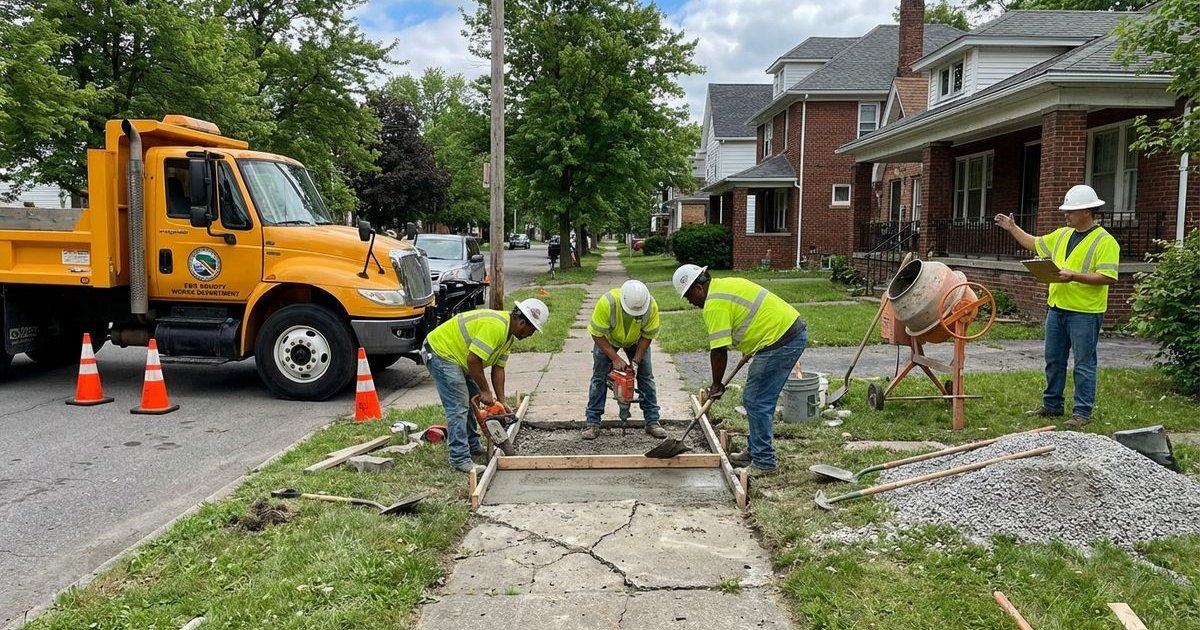
Municipalities and property managers across Western New York face a relentless annual battle: maintaining miles of pedestrian infrastructure against the brutal freeze-thaw cycles of Lake Erie winters.
We see it every spring.
The snow melts, revealing heaved slabs and new trip hazards that weren’t there in November.
Concrete leveling offers a strategic advantage in this battle, allowing you to stretch limited infrastructure dollars significantly further than traditional replacement.
The Municipal Sidewalk Challenge in WNY
Managing sidewalk safety in Erie and Niagara Counties is more than just a maintenance task; it is a complex balancing act of liability and logistics.
Local governments and commercial managers are dealing with:
- Accelerated Weathering: Western New York’s rapid freeze-thaw cycles cause ground movement that heaves slabs long before the concrete itself has failed.
- The “Prior Written Notice” Dilemma: Under New York General Municipal Law, knowing about a defect often triggers an immediate duty to repair, creating a “race against the clock” for liability.
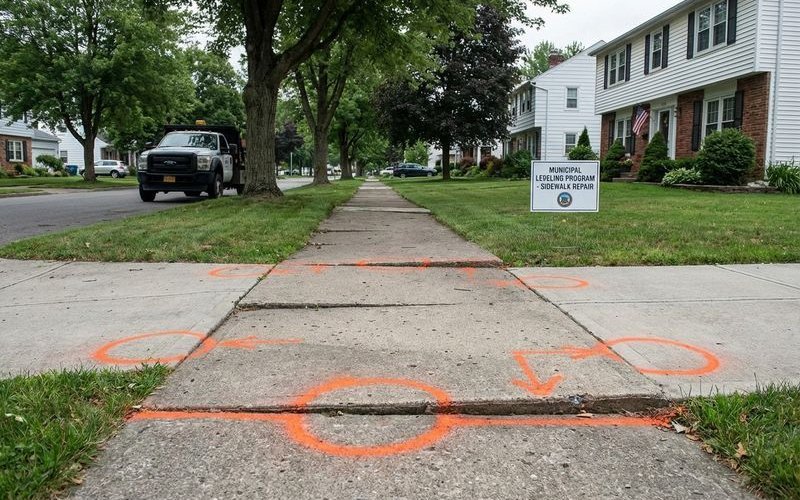
- Strict ADA Compliance: The Americans with Disabilities Act (ADA) defines a trip hazard as any vertical change of just 1/4 inch or more.
- Tree Root Conflicts: Mature maples and oaks in historic neighborhoods like North Buffalo or Lewiston frequently uplift sections that are otherwise structurally sound.
Replacing every lifted slab is simply not mathematically possible with current municipal budgets.
Leveling vs. Replacement: The Numbers
From our experience working with local comptrollers and highway superintendents, the decision often comes down to pure volume.
How many liabilities can you eliminate with your fixed budget?
We have broken down the 2025-2026 comparative costs for Western New York infrastructure projects:
| Factor | Full Concrete Replacement | Concrete Leveling |
|---|---|---|
| Cost Per Section | $900 - $1,600+ | $200 - $450 |
| Hazards Fixed per $50k | 30 - 55 sections | 125 - 250 sections |
| Time to Traffic | 7+ Days (Cure time) | Immediate (Same day) |
| Disruption Level | High (Heavy equipment, forms) | Low (Drill & pump only) |
| Carbon Footprint | ~400 lbs CO2 per yard | Negligible |
Key Takeaway: You can remove 300% to 500% more trip hazards annually by leveling existing concrete rather than replacing it.
How Our Municipal Programs Work
We have refined our workflow to integrate seamlessly with Department of Public Works (DPW) operations and commercial maintenance schedules.
Phase 1: High-Tech Assessment
We don’t just walk the sidewalk; we generate data.
- GIS Integration: We can map specific hazard locations to your existing GIS layers.
- Prioritization Logic: We identify high-risk zones (school routes, senior centers) for immediate remediation.
- Detailed Documentation: Every hazard is measured and photographed pre-repair to establish a baseline for your records.
Phase 2: Strategic Planning
Your budget cycle drives our schedule.
- Multi-Year Roadmaps: We help you plan a 3-5 year rotation to cover your entire jurisdiction.
- Resident Communication: We provide templates for notifying homeowners about upcoming work, reducing calls to Village Hall.
Phase 3: Surgical Execution
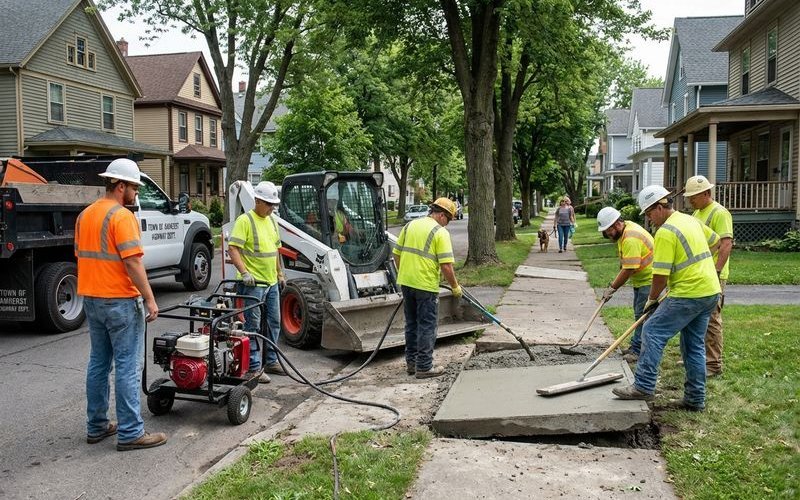
Our crews move fast to minimize public inconvenience.
- Neighborhood Sweeps: We tackle entire blocks efficiently, often completing 20-40 sections in a single day.
- Traffic Management: Since we don’t need cement mixers or dump trucks blocking lanes, traffic disruption is virtually non-existent.
- Immediate Access: Residents can walk on their sidewalks the moment we leave the site.
Why Shift to a Leveling-First Strategy?
1. Budget Efficiency
You stop burying money in landfills. By saving structurally sound slabs that have merely settled, you reserve your expensive replacement budget for the concrete that is truly crumbled or shattered.
2. Defensible Liability Management
Proactivity is your best legal defense. Demonstrating a systematic, high-volume repair program shows “reasonable care” in maintaining public rights-of-way. Eliminate the hazard permanently rather than grinding it down, which often leaves an unsightly and temporary scar.
3. Sustainability Goals
Every yard of concrete you don’t pour saves the environment. Cement production is responsible for roughly 8% of global CO2 emissions. Leveling recycles the existing material, directly supporting your municipality’s green infrastructure initiatives.
The Shared-Cost “50/50” Model
Many Western New York villages have successfully stretched their budgets by partnering with residents.
This model is particularly effective for defects caused by homeowner-owned trees or service lines:
- The Problem: A homeowner is quoted $1,500 by a private contractor to replace a heaved sidewalk block. They delay the repair due to cost.
- The Solution: The municipality organizes a leveling program. The bulk rate brings the cost down to $300 per section.
- The Split: The town pays $150, and the homeowner pays $150.
Participation rates soar because the cost is manageable, and the town eliminates a liability for a fraction of the expense.
Case Study: A Systematic Approach
A typical successful program in a WNY village follows this timeline:
Year 1: Triage
- Survey all districts.
- Fix the “Severity 1” hazards (1+ inch differentials) near schools and commercial districts.
Years 2-4: Rotation
- Divide the municipality into 3 zones.
- Perform comprehensive leveling in one zone per year.
- Re-assess the “Severity 1” list annually.
Ongoing: Maintenance
- Shift to a preventative check-up every 5 years to catch settling early.
Navigating Procurement & Compliance
We understand the paperwork is as important as the concrete work.
Our team is experienced with the specific requirements of New York municipal procurement:
- Prevailing Wage: We are fully compliant with NYS Department of Labor schedules.
- Insurance: We carry the requisite liability and workers’ comp thresholds for municipal contracts.
- Piggybacking: We can help identify if existing county or state contracts allow you to bypass a lengthy bid process.
Leveraging State & Federal Funds
Sidewalk leveling often qualifies for funding streams that replacement projects deplete too quickly.
Check your eligibility for:
- CHIPS (Consolidated Local Street and Highway Improvement Program): While often used for paving, sidewalk maintenance that extends service life can sometimes qualify.
- PAVE-NY: Funds specifically targeted at physical infrastructure rehabilitation.
- CDBG (Community Development Block Grants): Ideal for improving accessibility in eligible census tracts.
- Safe Routes to School: Federal funds dedicated to improving walking infrastructure near K-8 schools.
Using a lower-cost leveling method allows these grant dollars to impact 3x more linear feet than replacement.
Getting Started
If you manage infrastructure for a town, village, or large commercial property, you don’t have to wait for the next budget crisis to act.
- Audit: We will walk a pilot neighborhood with you to demonstrate the scope of savings.
- Scope: We build a proposal based on “Severity 1” hazards first.
- Execute: We mobilize our crews and eliminate your backlog.
Contact us today to review your sidewalk inventory and build a leveling plan that makes sense for your taxpayers.
Call (716) 261-2142 or email us to schedule a municipal consultation.