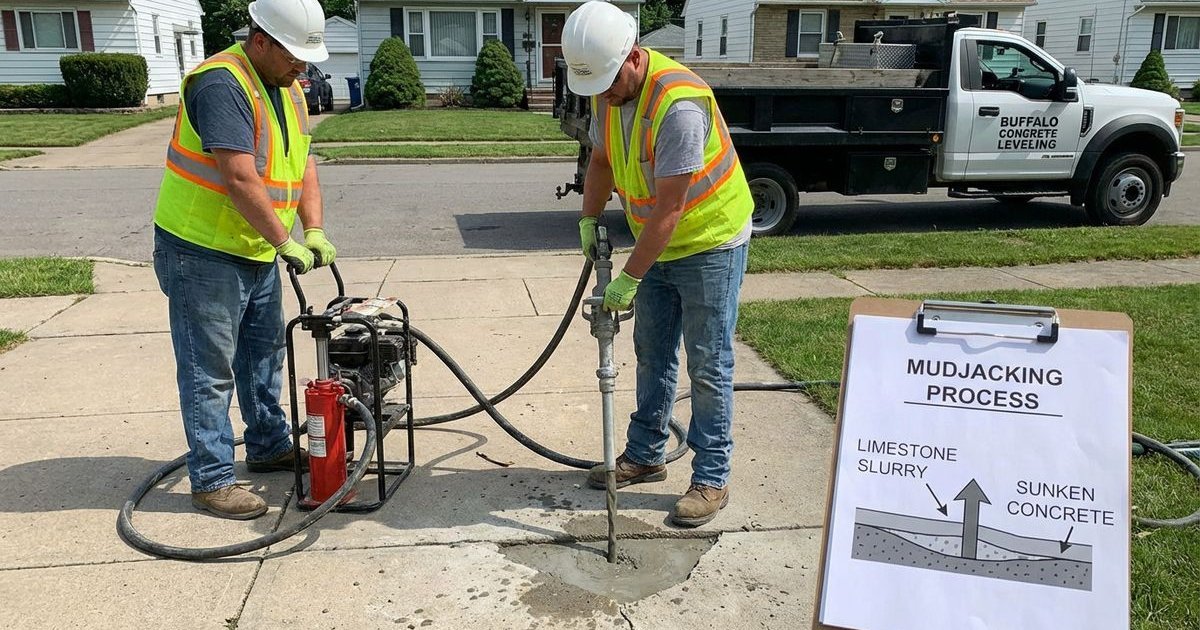
If you’ve lived in Western New York for any length of time, you know exactly what our winters do to concrete. One week it’s freezing, the next it’s thawing, and suddenly your perfectly level driveway has dropped two inches on the left side.
From what we see in the field, this isn’t just about a slab sinking; it’s about the soil underneath giving up. The confusion for most homeowners starts when they look for a fix and get hit with two very different options: mudjacking and polyjacking.
We are going to break down the real cost differences, the technical pros and cons of each, and why our team usually points Buffalo residents toward one specific method.
The Terminology
Let’s clear up the industry jargon so you know exactly what contractors are selling you.
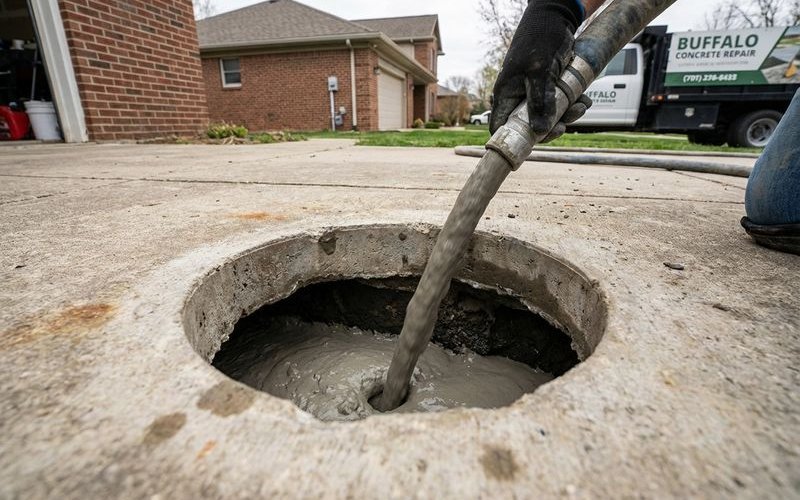
- Mudjacking: This is the traditional method where we pump a cement-based “slurry” (a mix of limestone, water, and Portland cement) under the slab.
- Polyjacking: This relies on a two-part polyurethane chemical mixture that expands into a rigid foam to lift the concrete.
- Slabjacking: You might hear this used as a catch-all term for lifting concrete from below, regardless of the material used.
Think of mudjacking as “re-concreting” the foundation under your slab, while polyjacking is more like inserting a high-tech, expanding pillow.
How Each Method Works
Mudjacking Process
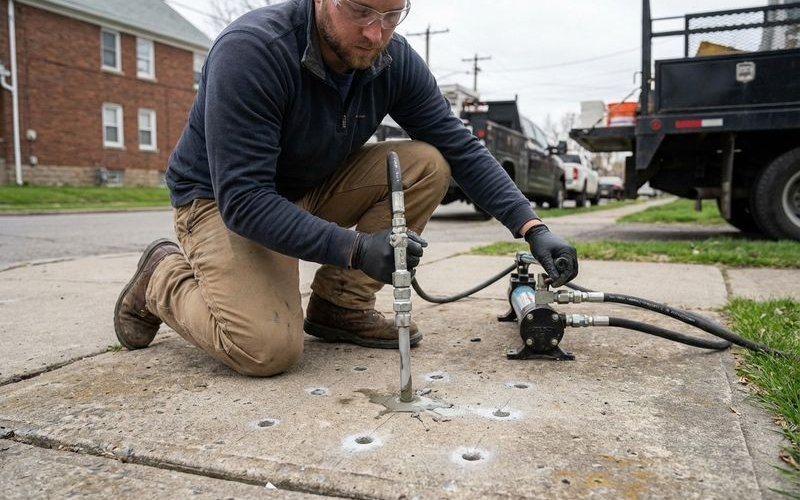
- Drilling: Our crew drills 1-inch holes (about the size of a quarter) through the sunken concrete.
- Pumping: We use hydraulic pressure to pump the limestone slurry deep beneath the slab.
- Lifting: The slurry fills the voids, pressurizes the space, and physically lifts the concrete back to level.
- Curing: The material hardens into a solid, stone-like base that supports the weight.
- Finishing: We patch the holes with fresh concrete and wash down the area.
Polyjacking Process
- Drilling: Technicians drill smaller holes, typically 5/8 of an inch (about the size of a penny).
- Injection: A two-part polyurethane liquid is injected through a port.
- Expansion: The chemicals react and expand rapidly (often 15 to 20 times their liquid volume) to lift the slab.
- Curing: The foam reaches full rigidity in about 15 to 30 minutes.
- Finishing: Holes are patched and the site is cleaned.
Key Differences
The choice often comes down to budget and specific site conditions. Here is how the numbers compare for 2026.
| Factor | Mudjacking (Limestone Slurry) | Polyjacking (Polyurethane Foam) |
|---|---|---|
| Material | Natural limestone & cement | Synthetic chemical foam |
| Cost (Est.) | $3 - $6 per sq. ft. | $5 - $25 per sq. ft. |
| Weight | ~100-140 lbs per cubic foot | ~2-4 lbs per cubic foot |
| Strength | High (Compressive Strength ~2,400 PSI) | Moderate (Residential Foam ~50-100 PSI) |
| Cure Time | Walkable in 24 hours | Ready in 15-30 minutes |
| Hole Size | 1 inch | 5/8 inch |
Advantages of Mudjacking
Superior Stability and Strength
We prefer limestone slurry because it creates a dense, rock-hard foundation. With a compressive strength that can exceed 2,400 PSI, it essentially replaces the eroded soil with a material that is harder than the dirt itself. This density prevents the “floating” effect that can sometimes happen with lighter materials in water-saturated ground.
Significant Cost Savings
Homeowners are often surprised by the price gap. Mudjacking typically costs 30-50% less than polyjacking. Since the materials (crushed limestone and water) are locally sourced and abundant, we don’t have to pass on the high manufacturing costs of synthetic chemicals to you.
Environmental Friendliness
Our limestone slurry is a natural product. It is simply crushed rock and water. There are no chemical reactions releasing heat or gasses, and if you ever remove the concrete in the future, the fill material is just clean fill, not a chunk of plastic foam.
Soil Stabilization
The slurry does more than just lift. Because it is fluid and heavy, it flows into the surrounding soil matrix and fissures. This stabilizes the sub-base and helps prevent future erosion by blocking water pathways under your driveway.
Advantages of Polyjacking
Immediate Cure Time
If you are running a commercial business and cannot close your entryway for a day, foam is the winner. The chemical reaction finishes in minutes. You can often drive on the repaired slab before the truck even leaves the property.
Smaller Injection Holes
The drill holes are roughly 40% smaller than mudjacking holes. For decorative stamped concrete or exposed aggregate patios where aesthetics are the absolute top priority, these smaller patch marks are easier to hide.
Lightweight Material
Foam weighs only 2-4 pounds per cubic foot compared to mudjacking’s 100+ pounds. This is beneficial in very specific scenarios, such as lifting a concrete slab that sits over unstable peat moss or a utility line that cannot handle extra weight.
Which Is Better for Buffalo?
For the vast majority of residential projects in Western New York, mudjacking is the practical winner.
Climate suitability: Buffalo sees nearly 100 freeze-thaw cycles a year. We need a repair material that adds mass and density to the soil to fight frost heave. Limestone slurry provides that weight.
Cost savings: Most homeowners would rather save $500 to $1,000 on a driveway repair if the results are equally durable. The premium price of foam rarely justifies the difference for a standard sidewalk or garage floor.
Long-term reliability: Our team can show you mudjacking jobs from the late 90s that are still perfectly level today. While foam is a good product, it lacks that multi-decade track record in our specific local soil conditions.
Erosion control: Our region’s wet, clay-heavy soil often washes away, creating the voids that cause sinking. Heavy slurry fills those voids and packs the soil down; lightweight foam can sometimes sit on top of soft soil without compacting it.
When Polyjacking Might Be Preferred
While we champion mudjacking, we acknowledge that foam has its place. You might choose polyjacking if:
- You have high-end decorative concrete: The smaller holes preserve the look of expensive stamped patterns.
- Time is critical: A warehouse loading dock that needs to be active in one hour requires foam.
- The site is inaccessible: If we cannot run our hoses to the site, foam equipment is sometimes easier to transport into tight backyards or basements.
- Weight is a structural danger: If the slab is on a second story or over a sensitive structure, the lightweight nature of foam is mandatory.
Questions to Ask Contractors
When you call around for quotes in the 716 area code, protect yourself by asking these specific questions:
- “What is the compressive strength (PSI) of your material?” (You want a number, not just “it’s strong.”)
- “Is your warranty prorated?” (Some warranties lose value over time; ours is straightforward.)
- “How do you handle water runoff?” (The contractor should explain how they will prevent water from getting back under the slab.)
- “Can you provide addresses of jobs you did 10 years ago?” (Long-term proof matters more than a fresh photo.)
- “Does your quote include caulking the cracks?” (Lifting without sealing the cracks is a waste of money.)
Our Recommendation
After three decades of leveling concrete across Western New York, we stand firmly behind limestone slurry mudjacking for 90% of residential needs.
It saves you money. The material is natural and proven. Our heavy slurry stabilizes the soft Buffalo soil better than light foam.
We are ready to look at your sinking concrete and give you a straight answer on whether you can save money with mudjacking or if you truly need the high-tech alternative.
Contact us today for a free assessment and a quote that makes sense for your budget.