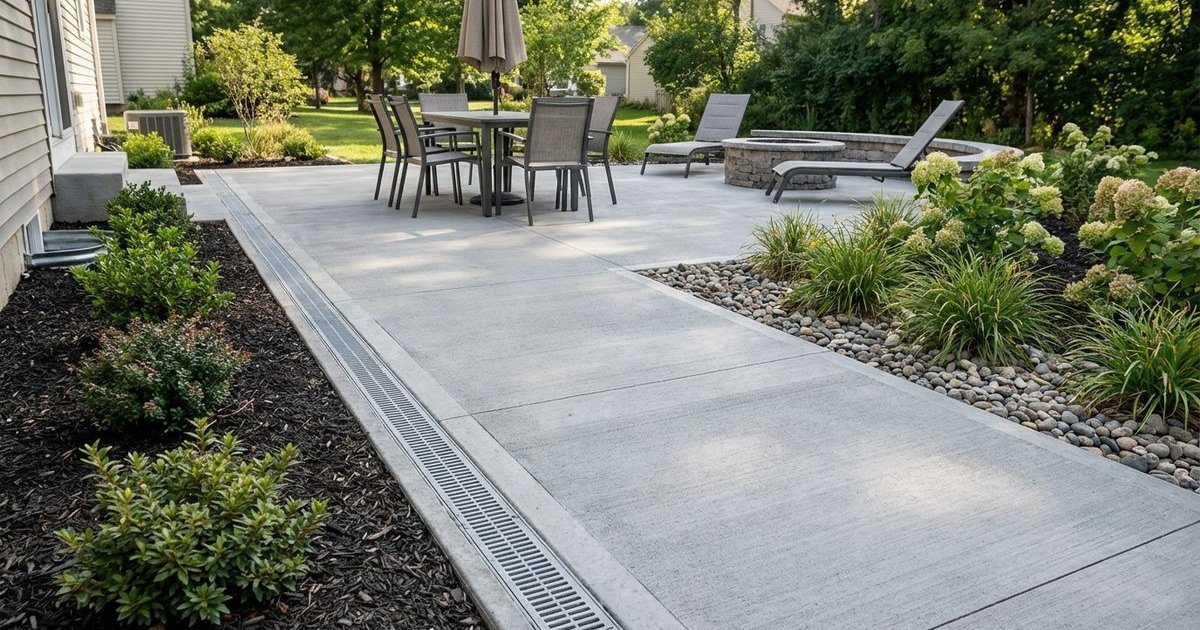
How to Prevent Patio Settling: 7 Tips from Buffalo Concrete Experts
Whether you’ve just had your patio leveled or want to protect a new patio from future problems, these seven tips will help prevent settling in Buffalo’s challenging climate.
From what we’ve seen in the field, most settling issues usually boil down to one specific culprit: unmanaged water interacting with clay soil.
Western New York’s freeze-thaw cycles create a unique challenge that makes standard maintenance advice insufficient for our region. We’re going to break down exactly how to manage these local soil conditions and walk you through the specific maintenance steps that actually work.
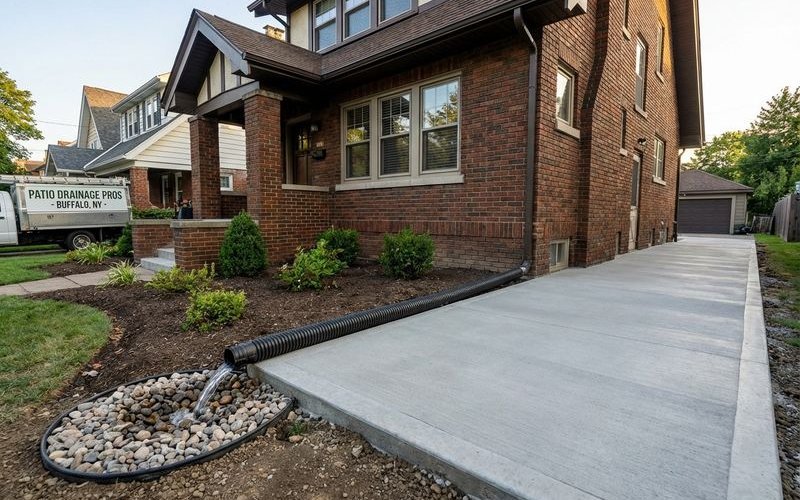
1. Manage Your Downspouts
We consider this the single most important thing you can do to protect your concrete.
A standard 1,000-square-foot roof sheds roughly 600 gallons of water during a mere one-inch rainstorm. If that massive volume dumps right next to your patio, it saturates the clay soil underneath, turning it into unstable mud that leads to sinking.
What to do:
- Extend downspouts at least 4-6 feet away from your patio or foundation.
- Use rigid PVC piping for buried lines instead of corrugated pipe, which clogs easily.
- Consider rain barrels to capture some runoff.
- Never let downspouts discharge at patio edges.
2. Seal Your Expansion Joints
Those gaps between patio sections exist to allow movement, but they are also the fastest way for water to destroy your slab’s foundation.
We always check these joints first because water flowing through them erodes the soil directly beneath the concrete. This process, known as “washout,” creates voids that eventually cause the slab to crack and settle.
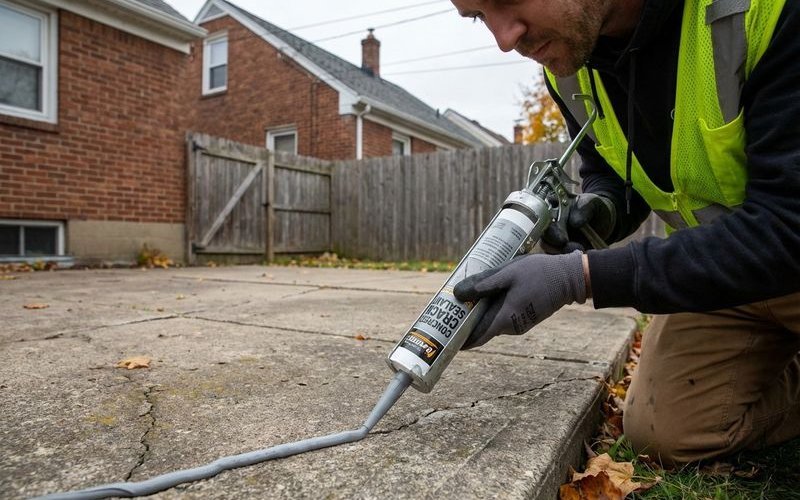
The “Insider” Solution: Polyurethane Avoid cheap silicone caulks found at general hardware stores. You need a self-leveling polyurethane sealant. This material stands up to Buffalo’s temperature swings better than silicone and resists abrasion from foot traffic.
When to seal:
- After new patio cures (28 days)
- After leveling work
- When existing caulk fails
- Before winter each year (inspect annually)
3. Maintain Proper Grade
Your patio should slope slightly away from your home to ensure positive drainage.
We generally look for a slope of about 1/4 inch drop for every foot of distance. If your patio is flat or slopes toward the house, water will pool against the foundation, softening the soil that supports the slab’s weight.
Warning signs of grade problems:
- Water flowing toward your house
- Puddles forming near the foundation
- Wet basement walls after rain
If your patio slopes wrong, leveling can correct it.
4. Address Cracks Promptly
Cracks are water highways into the soil beneath your patio.
We tell homeowners to use the “Dime Test” to decide when to act. If a crack is wide enough to slide a dime into, it is wide enough to let significant water penetrate and freeze, which forces the crack open further.
Crack filling tips:
- Clean out debris with a wire brush or vacuum before filling.
- Use a flexible polyurethane crack filler, not rigid concrete patch (which will pop out).
- Fill when concrete is dry.
- Overfill slightly (it will settle).
5. Keep Edges Protected
Patio edges are vulnerable points where water can easily undermine the slab.
We often see “edge drop” happen because the soil alongside the patio washes away, leaving the concrete rim unsupported. This is particularly common in clay soils that shrink when they dry out in summer.
Edge protection methods:
- Keep soil or mulch built up to the very top edge of the concrete.
- Install plastic or metal edging to hold garden soil in place.
- Keep grass trimmed along edges to prevent root intrusion.
- Fill any gaps between concrete and landscaping immediately.
Exposed edges invite water erosion.
6. Apply a Concrete Sealer
Sealing your patio protects against water penetration through the concrete surface itself.
This is especially important in Buffalo’s freeze-thaw climate, where absorbed water expands by 9% when it freezes, causing the surface to flake or “spall.” We strongly recommend using a Silane-Siloxane penetrating sealer rather than a film-forming acrylic.
Why Silane-Siloxane? It soaks deep into the pores of the concrete to create a hydrophobic barrier that won’t peel or flake off like surface coatings do.
Sealing recommendations:
- Apply penetrating sealer (not film-forming)
- Reseal every 3-5 years for penetrating sealers.
- Best applied in spring or fall
- Clean concrete thoroughly first
Sealing also protects against salt damage and staining.
7. Address Problems Early
The earlier you catch settling, the easier and cheaper it is to fix.
We know that a small dip today can turn into a major trip hazard after just one bad winter. Catching a shift when it’s only half an inch makes the repair process significantly faster and less invasive.
Monitor for:
- New cracks appearing
- Water pooling in new locations
- Doors sticking (for attached patios/porches)
- Visible unevenness
Small problems become big problems. Early intervention prevents expensive repairs.
Bonus: What NOT to Do
Avoid these common mistakes:
- Don’t let lawn sprinklers hit patio edges - Constant wetting and drying cycles degrade the soil stability.
- Don’t pile snow against the patio - As that snow melts, it creates a concentrated flood zone right at your foundation.
- Don’t ignore drainage changes - If a neighbor changes their landscaping, watch where their water goes.
- Don’t use salt carelessly - Rock salt eats away at the cement paste; use sand or magnesium chloride instead.
Already Have Settling?
If your patio has already settled, these tips won’t reverse the damage - but they’ll prevent it from getting worse after we level it.
Professional patio and porch leveling restores your patio to proper grade, and following these maintenance tips will keep it there for years to come.
Get Professional Help
If you’re dealing with settling that’s already occurred, contact us for a free assessment.
We’ll evaluate your patio, identify what caused the settling, and recommend the best solution.
Prevention is ideal, but leveling is the smart fix when settling has already happened.