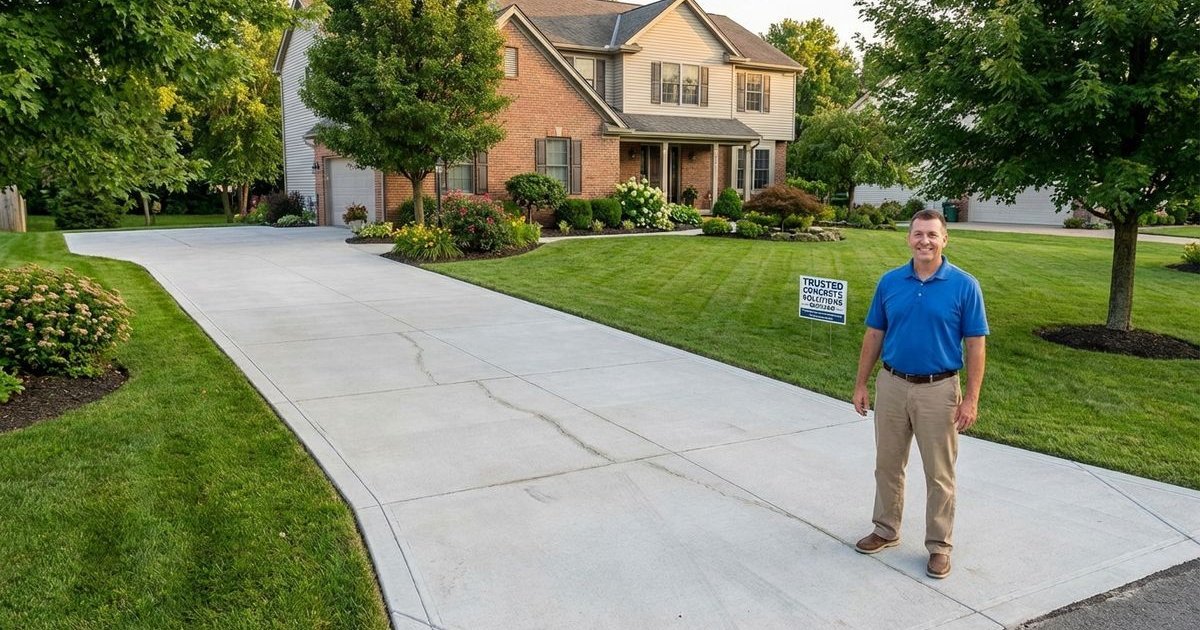
One of the most common questions Buffalo homeowners ask is: “How long will concrete leveling last?”
You know how brutal a Buffalo winter can be on your driveway—one day it’s 40 degrees and raining, the next it’s 10 degrees and snowing. From what we’ve seen, that constant freeze-thaw cycle is exactly what wreaks havoc on your concrete slabs.
It’s natural to worry that a repair might just be a temporary bandage.
The Short Answer
Quality concrete leveling with limestone slurry typically lasts 8-10 years or more. In fact, many of our repairs in the Western New York area are still holding strong after 15+ years, effectively lasting as long as the concrete slab itself.
The longevity of your repair depends on a few specific factors, which we will break down below.
Factors That Affect Longevity
The durability of your leveled concrete isn’t random; it’s determined by physics and geology.
1. The Leveling Material Used
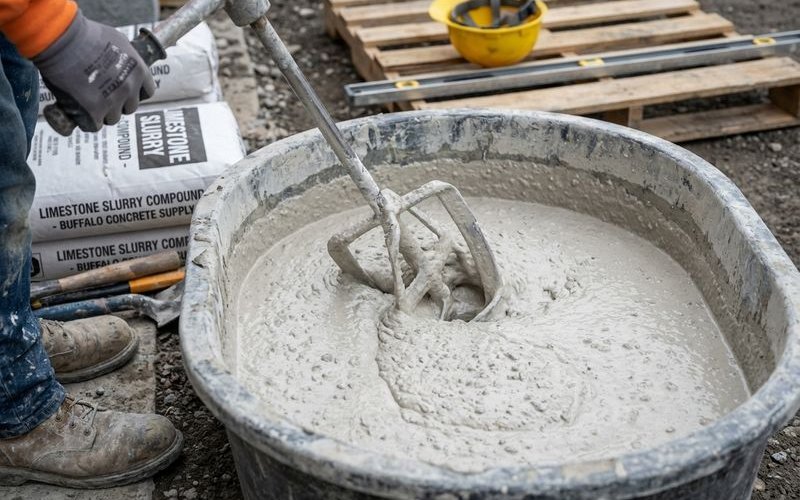
Not all leveling methods are created equal. We exclusively use limestone slurry because, in our experience, it offers superior stability for our specific soil conditions compared to polyurethane foam.
| Feature | Limestone Slurry (Our Method) | Polyurethane Foam |
|---|---|---|
| Compressive Strength | 2,000 - 4,000+ PSI (Similar to concrete) | ~100 PSI (High-density foam) |
| Void Filling | Flows to fill all voids completely | Expands blindly (can leave gaps) |
| Load Bearing | Excellent for heavy vehicles/traffic | Good, but can compress under extreme weight |
| Cure Time | 24 hours for vehicles | 15-60 minutes |
| Est. Lifespan | 10-20+ Years | 5-10 Years |
Why this matters: Limestone slurry is a cementitious mixture that hardens to become structurally similar to the concrete itself. It creates a dense, solid base that doesn’t just lift the slab but stabilizes the ground underneath it.
2. Why the Concrete Settled
Understanding the root cause is the key to a permanent fix.
- Poor Soil Compaction: This is the most common cause. Once we fill the void with our dense limestone mixture, the problem is usually solved permanently because the base is now solid.
- Soil Erosion: If water is actively washing away soil (common in Buffalo’s clay-heavy glacial till), we may need to address drainage first.
- Tree Root Decay: If a tree was removed and roots are rotting, voids form. Filling these with slurry provides a permanent solution.
- Active Water Problems: Leveling is a waste of money if you don’t fix a broken pipe or downspout first.
3. Drainage Conditions
Water is the enemy of concrete stability. If water continues to flow beneath your concrete, it can eventually wash away supporting material—even new fill.
We often recommend these simple adjustments to protect your investment:
- Extend downspouts at least 5-10 feet away from the concrete.
- Regrade soil near foundations to slope away at a rate of 1 inch per foot.
- Install drain channels if water pools near your garage or walkway.
- Seal joints (caulking) immediately after leveling to stop surface water from getting under the slab.
4. Buffalo’s Climate
Our region averages around 42 freeze-thaw cycles per year. This constant expansion and contraction of the soil is what cracks and lifts concrete.
Limestone slurry is particularly well-suited for this environment because:
- It is a dense, heavy material that resists the “heave” of frost better than lightweight foam.
- It doesn’t absorb water significantly once cured.
- It stabilizes the surrounding soil, reducing the movement that occurs during those 40+ annual freeze cycles.
Is It Worth the Cost?
Many homeowners worry about spending money on a repair versus a full replacement. From a financial perspective, leveling is almost always the smarter first option.
The Data:
- Cost Savings: Concrete leveling typically costs 50-70% less than tearing out and replacing the slab.
- Price Comparison: While replacement can cost $8.00 - $15.00+ per sq. ft., leveling usually runs between $3.00 - $6.00 per sq. ft. depending on the job size.
You get a repair that lasts a decade or more for a fraction of the price of new concrete.
Our Warranty
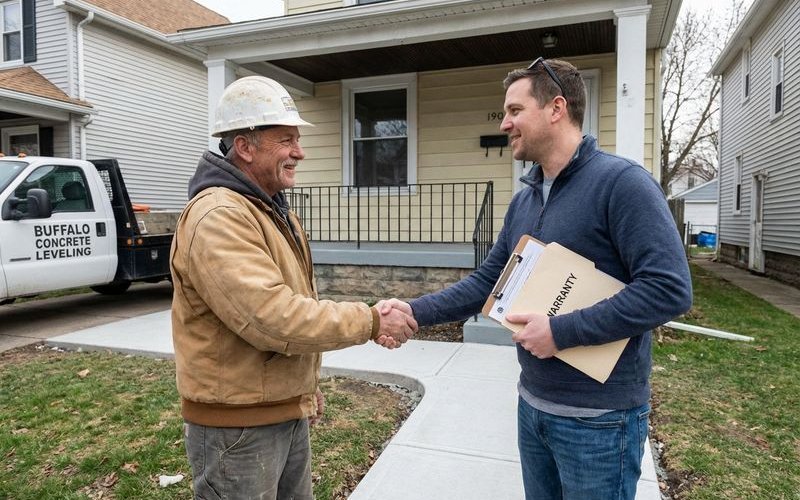
We stand behind our work with a multi-year warranty. If leveled concrete re-settles during the warranty period, we’ll address it at no additional cost.
This isn’t just a piece of paper; it’s our promise that the job was done right. We assess the underlying soil stability before we ever drill a hole, ensuring we only take on jobs that can be permanently fixed.
When Leveling Might Not Last
We believe in honest assessments. In some situations, leveling may not be the right long-term solution, and we will tell you that upfront:
- Active erosion where water flow cannot be diverted.
- Crumbling concrete where the slab itself is too deteriorated to lift without breaking.
- Ongoing soil instability (like a sinkhole) that requires deep foundation work.
- Heavy equipment zones where the load exceeds the slab’s design (e.g., a residential driveway being used for heavy commercial trucks).
Extending the Life of Your Repair
After we leave, you can take a few simple steps to maximize the longevity of the repair:
- Seal Open Joints: Use a high-quality polyurethane caulk to seal the expansion joints and cracks. This stops water from getting under the slab and freezing.
- Apply a Surface Sealer: For Buffalo winters, use a Silane-Siloxane penetrating sealer. Unlike acrylics that sit on top, this penetrates the pores to block salt and water damage.
- Manage Ice Melt: Avoid using rock salt (sodium chloride) which eats away at concrete. Use calcium chloride or magnesium chloride instead.
- Monitor Drainage: Keep an eye on your downspouts during heavy rains to ensure they aren’t dumping water right next to your driveway.
The Bottom Line
Concrete leveling with limestone slurry is a long-lasting solution for most settling problems. When done properly with quality materials and proper technique, you can expect your repair to last a decade or more.
We have been leveling concrete in Buffalo for over 30 years. Our experience and methods have been refined to provide maximum durability in our challenging climate.
Contact us for a free assessment, and we’ll give you an honest evaluation of how long a repair is likely to last in your specific situation.