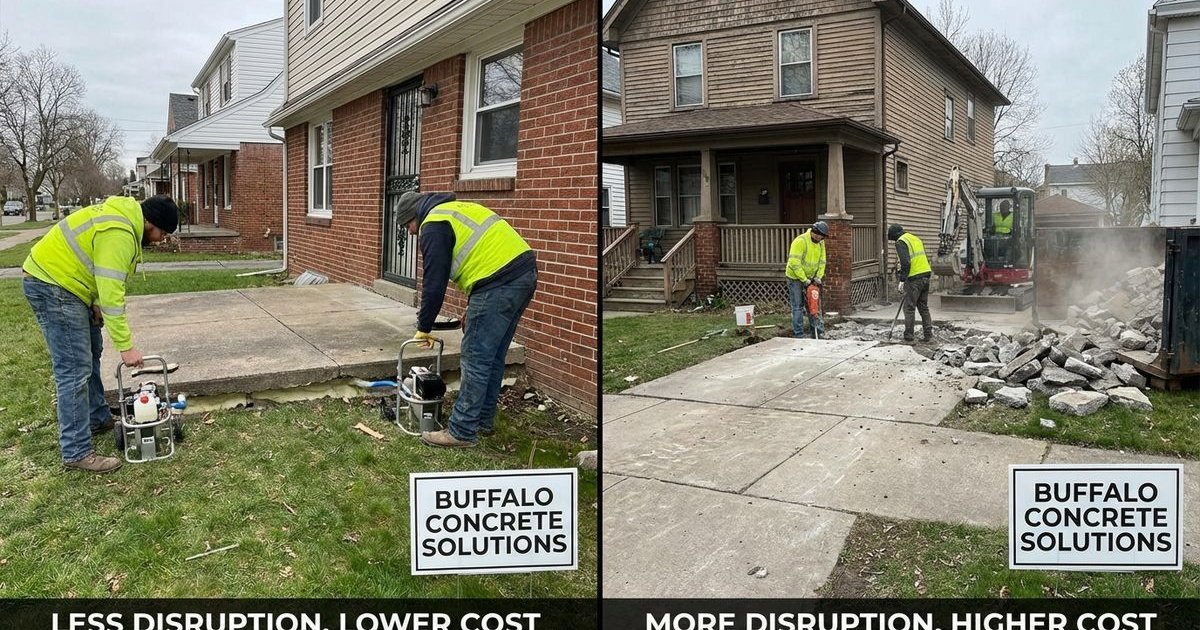
To make the right choice for your property, you need to look beyond the surface. We’ve seen firsthand how Buffalo’s unique climate—specifically the 100+ freeze-thaw cycles we endure every winter—can wreak havoc on concrete in ways that standard advice doesn’t account for.
When your concrete is uneven or sunken, you have two main options: level it or replace it. Both have their place, but for most situations in Western New York (WNY), leveling is the smarter choice. Let’s compare them honestly.
Cost Comparison
For most homeowners in the 716 area, the decision starts with the budget. We consistently find that leveling projects cost 50% to 70% less than tearing out and pouring new slabs.
The following table breaks down estimated costs for 2026 based on local Buffalo market rates:
| Project Size | Leveling Cost (Est.) | Replacement Cost (Est.) | Savings |
|---|---|---|---|
| Small Sidewalk Section | $400 - $600 | $1,200 - $1,800 | ~65% |
| Standard 2-Car Driveway | $900 - $1,800 | $5,000 - $9,000 | ~80% |
| Large Patio (300 sq ft) | $750 - $1,500 | $3,500 - $5,500 | ~75% |
| Garage Floor | $800 - $1,600 | $4,000 - $7,000 | ~75% |
Concrete leveling typically costs 70% less than replacement. That’s not a small difference—it’s often enough to cover your winter heating bills for the season.
The Hidden Costs of Replacement
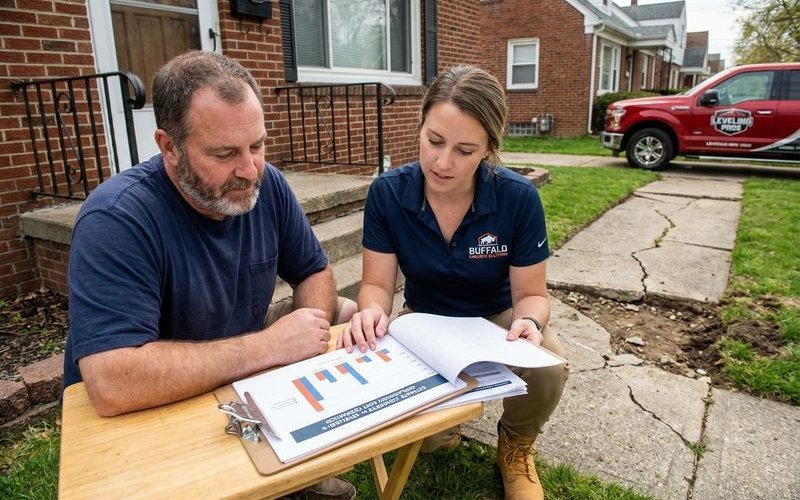
Many quotes for replacement only list the price per square foot for the concrete itself. You need to ask about the extras that often surprise homeowners.
- Permit Fees: The City of Buffalo and surrounding suburbs like Amherst or Cheektowaga often require permits for sidewalk replacement, which can add cost and delay.
- Landscape Repair: Heavy machinery (skid steers) used for demolition will tear up the grass alongside your driveway.
- Disposal Fees: Hauling away tons of old concrete to a landfill in Erie County isn’t free, and those dump fees are usually passed on to you.
Time and Disruption
If you’ve lived through a Buffalo winter, you know the urgency of getting projects done before the snow flies. We emphasize speed because leaving your driveway torn up for weeks in October is a risky game.
Concrete Leveling:
- Completed in hours (most jobs in 2-4 hours).
- Use your concrete immediately or within 24 hours.
- No demolition debris to haul away.
- Minimal noise and mess.
- One crew, one day.
Concrete Replacement:
- Takes days to weeks depending on contractor availability.
- 7+ day cure time before you can park on it (critical if street parking is limited).
- Demolition creates significant dust and debris.
- Heavy equipment, noise, disruption.
- Multiple trades may be involved.
For a typical driveway, leveling means you’re parking your car the next day. Replacement means parking on the street for a week or more, which can be a nightmare during street cleaning or snow plowing schedules.
Results Quality
Both methods can deliver excellent results, but they serve different aesthetic goals. A leveled driveway restores safety and function without changing the visual character of your home. The concrete surface remains unchanged—we’re simply restoring it to its original position.
Leveling advantages:
- Preserves your existing concrete’s weathered look.
- No “patchwork” effect where a bright white new slab clashes with older sections.
- Eliminates trip hazards immediately.
- Maintains the original landscaping edges.
Replacement advantages:
- Opportunity to change the design or widen the driveway.
- Brand new, pristine surface (though it will eventually weather).
- Can address severely damaged concrete that has crumbled.
A Note on Color Matching
One frequent complaint we hear about partial replacement is the “checkerboard” look. New concrete in Buffalo cures to a brilliant white/light grey, while your 20-year-old walkway is likely a darker, weathered grey.
Leveling keeps the color consistent across your entire property. If visual uniformity is important to you, lifting the existing slab is far superior to replacing just one or two squares.
When Leveling Is Better
In our experience working with WNY’s clay and silt soils, leveling is the superior option for settlement issues. The soil here shrinks and swells with moisture changes, causing slabs to sink while remaining intact.
Concrete leveling is the right choice when:
- The concrete itself is structurally sound (no crumbling).
- Settlement is due to soil compression or erosion (common near downspouts).
- Budget is a primary consideration.
- You need the area back in service immediately.
- You want to avoid the noise and mess of jackhammers.
- The concrete is relatively new (less than 10 years old) but settled improperly.
When Replacement Is Better
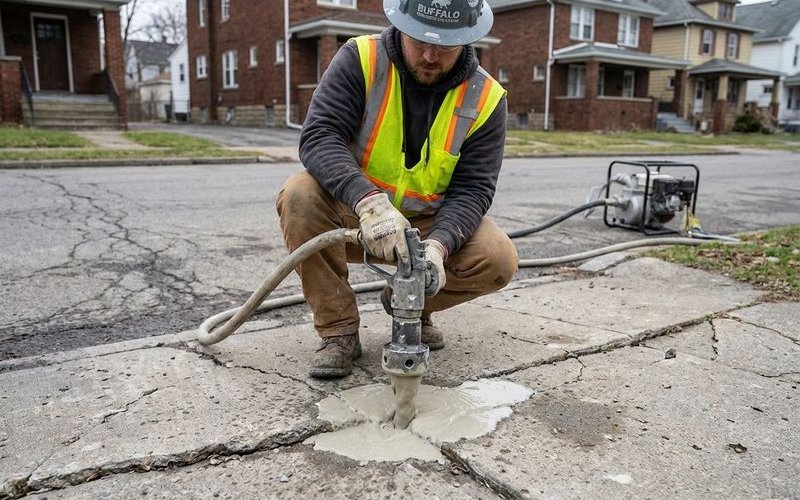
Sometimes, despite our best efforts, a slab is just too far gone. We believe in being upfront when leveling would just be a temporary band-aid.
Replacement is the right call if:
- The concrete is pulverized, crumbling, or turning to gravel.
- Active tree roots have lifted the slab significantly (leveling can’t remove roots).
- The slab has cracked into 4 or more small, unstable pieces.
- You want to change the shape, width, or grade of the driveway.
- The surface is spalling (flaking off) deeply due to years of road salt damage.
We’ll honestly recommend replacement when it’s the better option—we’re not going to level concrete that won’t hold up.
The Environmental Factor
Sustainability is becoming a bigger priority for many of our neighbors in the Queen City.
Replacement generates waste:
- Demolition creates tons of heavy debris.
- Old concrete often ends up in local landfills.
- New cement production has a massive carbon footprint.
- Trucks, excavators, and mixers burn significant diesel fuel.
Leveling is eco-friendly:
- Preserves your existing concrete, keeping it out of the dump.
- Minimal waste generated (often just a handful of dust).
- Limestone slurry or polyurethane foam are efficient materials.
- Smaller carbon footprint overall.
Making Your Decision
Ask yourself these four questions to simplify the choice:
- Is my concrete structurally sound, just uneven?
- Do I want to save roughly 70% on the project cost?
- Am I happy with the current size and layout of the area?
- Do I need to use the driveway or walkway within the next 24 hours?
If you answered “yes” to these questions, leveling is likely your best option.
Get a Professional Assessment
The best way to decide is to have an expert look at the specific soil conditions and concrete quality on your property. We provide free assessments and will honestly tell you whether leveling is appropriate for your situation.
If we think replacement is the better option, we’ll tell you—and we can recommend reputable concrete contractors in the Buffalo area.
Contact us to schedule your free assessment and get a clear comparison for your specific project.