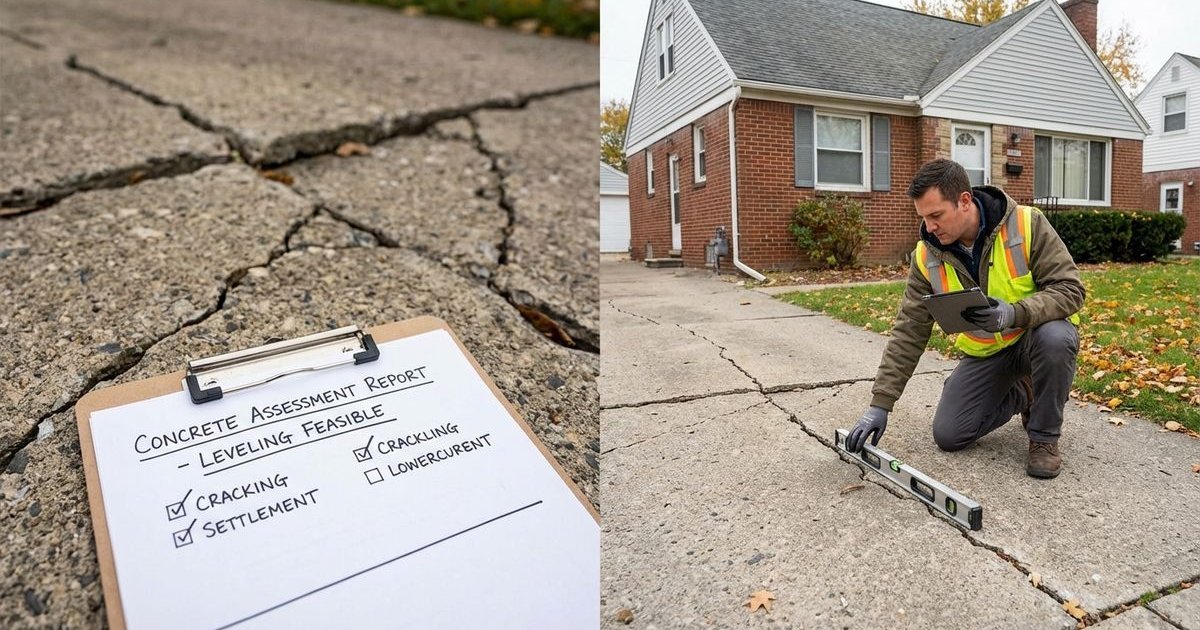
Your driveway has cracks AND it is uneven. Can you still have it leveled, or does the whole thing need to be ripped out?
The answer often depends on exactly how wide those cracks are and what caused them.
We tackle this question every day at Concrete Leveling Buffalo. Most homeowners are surprised to learn that a cracked slab is often perfectly salvageable.
The Short Answer
Yes, we can usually level cracked driveways.
Minor to moderate cracking does not prevent a successful lift in most cases. A general rule of thumb in the US concrete industry is that if the slab is intact enough to be walked on without moving, it is likely stable enough to be leveled.
However, there is a limit.
If the concrete is crumbled into gravel-like pieces or the cracks exceed 3/4 of an inch in width with significant separation, replacement might be the only viable path.
Types of Cracks and Whether Leveling Works
Not all cracks are created equal.
Identifying the specific type of damage helps us predict whether a repair will hold up against Western New York winters.
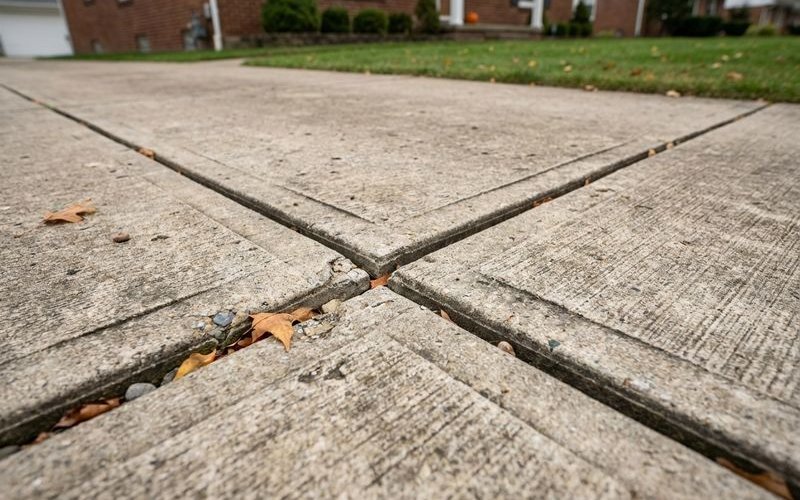
Control Joint Cracks - Yes, We Can Level
These are the straight lines cut into your driveway during installation. Contractors place these intentionally to give the concrete a specific place to crack as it shrinks and expands.
Can be leveled: Yes The technical reality: These are actually the easiest sections to lift because the concrete breaks cleanly along the pre-cut line.
What we do:
- Drill injection holes near the joint.
- Pump material to lift the independent sections.
- Seal the joint to prevent water from washing out the sub-base again.
Hairline Surface Cracks - Yes, We Can Level
These are thin fissures that look like a strand of hair.
They are typically less than 1/8 inch wide. You can test this yourself using the “Credit Card Test.” If a standard credit card cannot fit into the crack, it is likely just a surface issue.
Can be leveled: Yes What we do: We lift the slab normally. The foam or slurry supports the slab from below, which prevents the hairline crack from widening under the weight of your vehicle.
Settlement Cracks - Yes, We Can Level
These cracks appear when the soil underneath the driveway shrinks or washes away.
According to general engineering data, uncompacted fill soil can settle by up to 20% over time. This creates a void that causes the heavy concrete to snap under its own weight.
Can be leveled: Yes What we do: Lifting is actually the cure for this specific problem. By filling the void with high-density material, we stabilize the soil and often close the crack significantly as the slab returns to its original position.
Corner Cracks - Usually, We Can Level
You will often see triangular breaks at the very edge of the driveway where it meets the garage or street.
These are frequently caused by “slab curling,” where the top and bottom of the concrete cure at different rates.
Can be leveled: Usually yes What we do: We carefully inject material under the triangle piece to stabilize it. While we cannot “glue” the concrete back together, we can stop it from rocking or sinking further.
Alligator Cracking - Maybe
This looks exactly like it sounds. The concrete resembles the scales on an alligator’s back or a shattered windshield.
Can be leveled: Sometimes, if limited to small areas The risk factor: This pattern usually indicates that the concrete was mixed with too much water originally or has suffered severe freeze-thaw damage.
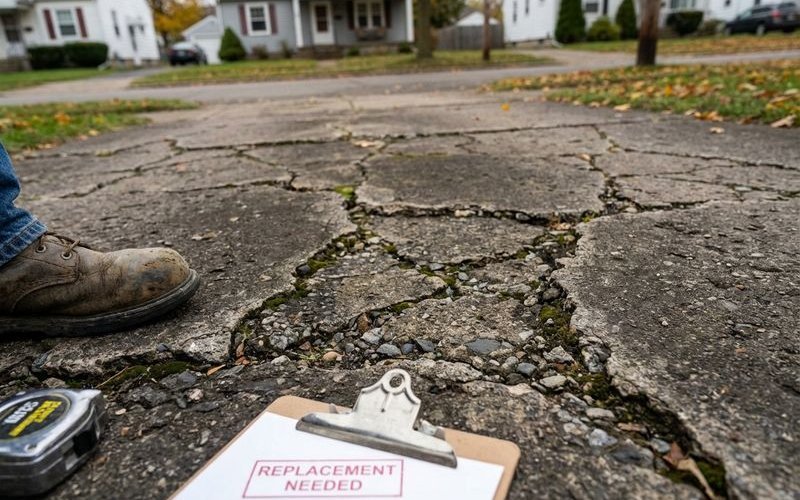
If the chunks are loose, they cannot be lifted.
Spalling/Flaking - Maybe
Spalling is surface deterioration where the top layer of concrete chips off.
This is extremely common in regions that use de-icing salts. Salt causes a chemical reaction that breaks the bond of the cement paste.
Can be leveled: The underlying slab can be lifted, but the surface will still look rough. What we do: We can fix the trip hazard caused by the uneven slab. The surface texture, unfortunately, requires resurfacing or patching to look new again.
Major Structural Cracks - Usually Not
These are large fissures wider than a half-inch that run through the entire thickness of the slab.
Can be leveled: Usually not Reason: The slab lacks the structural integrity to hold the pressure of the lifting material. If we pump foam or mud under it, the material just shoots out through the giant crack rather than lifting the concrete.
How We Assess Your Driveway
We look at more than just the surface.
To give you an accurate answer, we analyze six specific factors that impact the longevity of a repair.
- Crack Width: Is it a hairline fracture or a gap wide enough to trip over?
- Vertical Offset: How far has one side settled compared to the other? (Offsets over 2 inches are harder to fix).
- Sub-base Condition: Is there a hollow sound when we tap the concrete, indicating a void?
- Concrete Age: Is the slab 5 years old or 50? Concrete generally has a lifespan of 30-50 years depending on the mix quality.
- Drainage: Is water pooling near the crack? This is the number one cause of soil failure.
- Stability: Does the slab rock when a car drives over it?
Questions to Ask Yourself
You can do a quick self-diagnosis before picking up the phone.
Ask yourself these four questions to gauge the severity of the damage:
- Is the crack actively growing? Take a photo today and compare it to a month from now. Active movement means the soil is still settling.
- Do the pieces rattle? Jump on the corner of the slab. If it moves or makes a clinking sound, the support below is gone.
- Is the surface turning to gravel? If you can sweep up a pile of concrete dust every week, the slab is likely too weak to lift.
- Is the concrete older than 40 years? At this age, replacement is often more cost-effective in the long run than repairs.
Cost Comparison: Leveling vs. Replacement
The financial difference is usually the deciding factor for homeowners.
We pulled average market data for 2025 to show you the stark contrast in pricing between repairing your existing concrete and pouring new slabs.
| Factor | Concrete Leveling | Concrete Replacement |
|---|---|---|
| Average Cost | $3.00 - $6.00 per sq. ft. | $12.00 - $18.00 per sq. ft. |
| Installation Time | 2-4 Hours | 2-4 Days |
| Wait Time to Use | Immediately / Same Day | 7-14 Days (Cure time) |
| Landscape Impact | Zero (Drill holes only) | High (Heavy machinery required) |
What We Will Honestly Tell You
We evaluate every driveway with a focus on long-term value.
If leveling makes sense, we will explain the exact process. If replacement is the better option, we will tell you that clearly.
We do not offer full pouring and replacement services. This means we have zero financial incentive to tell you a slab is “unfixable” just to upsell you a $10,000 driveway.
Our goal is to solve the problem, not sell a product that will fail in six months.
Combining Leveling with Crack Repair
The most effective repair strategy involves a three-step process.
We often recommend this “lift and seal” approach to extend the life of the driveway by another 10 to 15 years.
- Level First: We inject material to restore the proper grade and support the slab.
- Seal Cracks: We apply a high-modulus polyurethane sealant. Unlike rigid mortar, this flexible material moves with the concrete during thermal expansion.
- Caulk Joints: We seal the control joints to stop water from infiltrating the sub-base and causing new voids.
The Benefits of Leveling a Cracked Driveway
Choosing to level rather than replace offers immediate practical advantages.
- Cost Efficiency: You save roughly 50% to 70% compared to the price of a new pour.
- Speed: The crew is usually done in under half a day.
- Safety: You remove trip hazards immediately without waiting weeks for concrete to cure.
- Aesthetics: The existing concrete matches the rest of your property, avoiding that “patchwork” look of a partial replacement.
- Prevention: Stabilizing the slab stops the movement that is causing the cracks to spread.
Get an Honest Assessment
Not sure if your cracked driveway is a candidate for leveling?
Schedule a free assessment with our team. We will measure the offset, check the soil stability, and give you a straightforward recommendation based on the data.
Contact us today for a no-obligation evaluation.